Showing posts with label peregrine. Show all posts

Friday, 6 May 2022

Liverpool RSPB’s 2022 AGM 50th anniversary year- Anyone for cake?


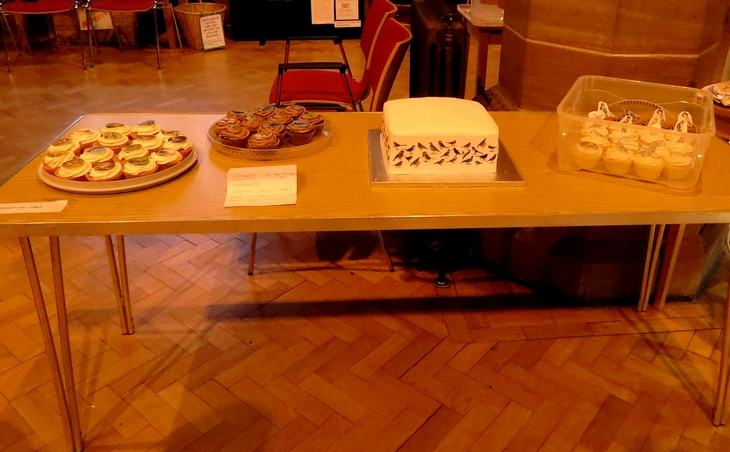
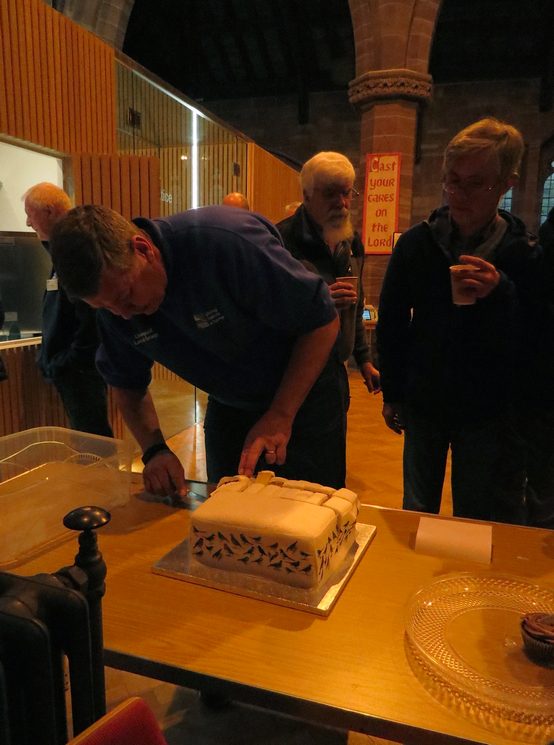
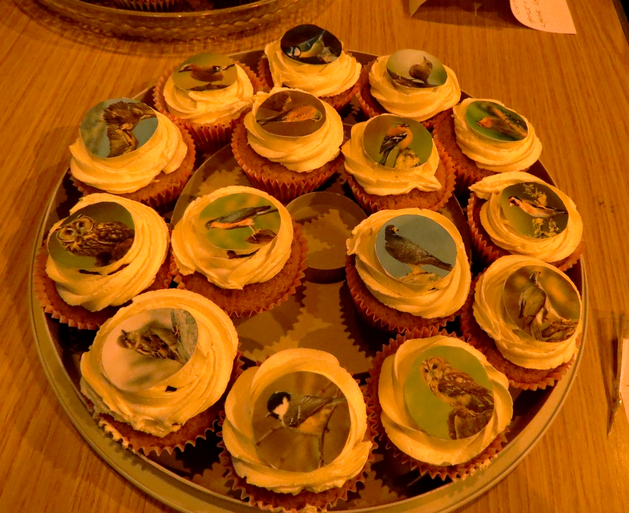
Liverpool RSPB’s 2022 AGM was a special evening, as it’s our 50th anniversary year, and quite rightly we celebrated with cake or should I say cakes. Local group member Anne Ludwig did us proud with 50 bird themed cupcakes and a large iced, layered sponge cake that Chris had the task of slicing up; also ensuring he had first dibs!


We also have 50 specially commissioned nest boxes, engraved with 'RSPB Liverpool 50yrs Giving Nature a Home', stock sold out on the night but more available on request.


Fifty nine of our members attended the meeting. Chris gave a Leaders report of the recent year’s activities and our future events. We went through the business of re-electing committee members, explaining expenditure and the group’s donation of £1500 to the Gough seabird appeal  (https://www.rspb.org.uk/our-work/conservation/projects/gough-island-restoration-programme/)   All attending were given the opportunity to ask questions, make requests or share ideas.

Alasdair McKee, the RSPB'S Local Groups Officer followed giving an expression of thanks for all Liverpool RSPB do from RSPB HQ and then went on to  regale us with snippets from Bird Notes & News, the original RSPB newsletter-
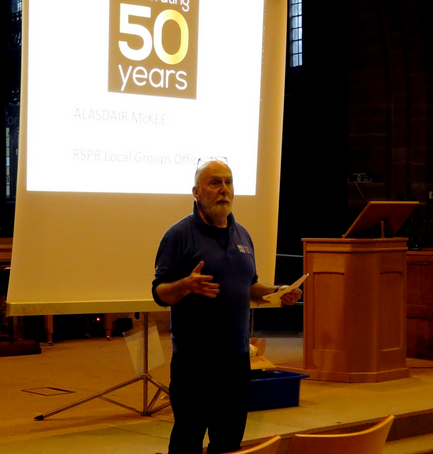
Alisdair Mckee


Did you know loathsome bird catching (still going on in the Mediterranean today sadly) was a general practice among English people in days past; for eating, plumage or entertainment?  Cage birds,nets and the abhorrent bird lime was freely advertised and songbirds were sold in big stores as food including skylarks  and fieldfares in season, and  the Southport  gun club, regularly held  starling shoots.

But all was not lost, in 1889, sickened by a slaughter of exotic birds for their feathers; Emily Williamson started the Society for the Protection of Birds aiming to campaign for change. 

I’m pleased to say our  neck of the woods played its part; In 1903 twenty  of the leading millinery firms in Southport held a  display show of plume free millinery at the RSPB Southport Branch and for 2 days in April their shop windows  were full of this trimmed millinery with the card ‘Without destruction to wildlife’… well done.

After campaigning tirelessly for change, the plumage (prohibition) Act was passed in July 1921, banning the import of plumage.  And Liverpool led the way in 1922, Liverpool succeeded in obtaining the first order issued in England protecting all wild birds throughout the year expressly to stop bird catching in the suburbs in the open season, congratulations to the Liverpool branch of the RSPCA and RSPB.


So what did Chris convey –?

The New RSPB website will be coming online shortly; in the meantime, the old site is still accessible showing details of future events.

Our peregrines, sited in the tower of Mossley Hill Church are doing well, and are expectant parents of 3. Male has been named Bruno, his lass is a girl from the midlands (ringed peregrine).

Chris liaising with RSPB HQ, and assisted by other local group members have been discussing and attempting to find solutions to the on-going problems of Liverpool’s netted high buildings, such as the Anglican Cathedral and Tobacco warehouse. These buildings have been netted for various reasons to stop Peregrines from breeding on them; to many a distressing situation and sadly not an uncommon practice throughout the country and often in the news. 

The RSPB resumed outdoor events in January. Our first being a replacement walk around Sefton Park, normally the group holds a ‘Big garden birdwatch’ event in the Palm House in January. To say it was popular was an understatement as approximately 80 people followed Chris along the paths; A mixture of regular members and those newly interested, several on the walk went on to the join the group and have  been out with us again.

Chris Tynan. RSPB Liverpool Jan 2022 Sefton Pk


Chris has been working with the NHS’s nature recovery rangers. Covering Aintree, broadgreen and the royal hospitals, a series of short local woodland health walks is what’s prescribed, in the fresh air embracing nature, connecting to green spaces to benefit their mental and physical health. Every hospital should have a ranger - https://www.youtube.com/watch?v=VKz7x2tjC6w&ab_channel=TheCentreforSustainableHealthcare


RSPB Liverpool will be on board for the two Birdwatching ferry cruises planned this year 16th July and 11rh of September. (Ticket Prices Adults - £20, Children aged (3-15) - £10)

https://www.merseyferries.co.uk/our-cruises/wildlife/bird-watching-cruises/#timetable-grid


Chris joined RSPB Liverpool in 1996, within a few years he was group leader.  In 2003 he was working for the RSPB on Southport pier, a testament to his skills in talking to, sharing his knowledge and enthusing the public about why birds were brilliant.  In 2018, Chris Tynan received the RSPB Presidents Award. The President’s award is given to 5 volunteers every year to highlight outstanding volunteering. Chris says birdwatching and carrying on with our group's leadership is what keeps him going, but warns someday we’ll need a replacement, yikes.


Well done local group member  Anne Ludwig, delicious


Cake ate or secreted away...Our meeting concluded with a talk from Chris about his favourite 50. His first recollected interest being inspired by blue tits, who were famed for sipping the cream out of the tops of doorstep milk bottles!

He told of magic moments at home, of adventures abroad and exotic locations, favourites from garden, woodland or sea, of agonising dipped birds. All had a memory attached, the bird or even the circumstances in which it was found.  I could list the birds, but that would be a spoiler for those who missed the talk, but might like to hear it in the future… from the Mersey Oystercatchers to the New Zealand little Blue Penguins, his list was an education in itself.


Laura

Thursday, 12 December 2019

RSPB Liverpool Group RSPB Burton Mere Trip and Boathouse Xmas Meal 7th December 2019

Peregrine hunting at Burton Mere - JBinks


And so we came to the group’s last field trip of 2019 – the annual visit to RSPB Burton Mere, followed by Christmas lunch at The Boathouse, Parkgate.
On a mild, grey day we started in the visitor centre (Reception Hide) overlooking the main scrape, scanning the water and islands for waders and ducks, and were rewarded with… a male peregrine, sitting on one of the islands, choosing lunch from the ‘menu’ of water birds around it. After a while, it took off, flying low over black-tailed godwits and wigeon, then, clearly still undecided, returned to its island. 

Marsh Harrier - J Binks
A marsh harrier seemingly perched on some reeds (obviously a post in amongst them) caught our attention then, and so some of us missed the peregrine, lunch choice now made, taking off again, selecting a black-tailed godwit and settling down with it. But no! Lunch wasn’t to be: a carrion crow had other ideas, and we watched in awe as the peregrine, thoroughly frustrated, chased one bird away, putting on a spectacular turn of speed, then flew off empty-taloned.

All the gang. -  Paul Wakelam
Speaking of Christmas, it was time for the group to split up. Some made the short journey to the Boathouse and a fine Christmas lunch attended by a male hen harrier, great and little egrets, and views of three marsh harriers in the skies at the same time over the marsh. One of our number lingered at Burton Mere, enjoying a pleasant wander through the crisp leaves along Gorse Covert woodland trail, with views of a sparrowhawk amongst the trees, and a final visit to Reception Hide, which produced two marsh harriers interacting in the sky over the reedbed.

Thanks to all group officials, volunteers and members for another great year. Don’t forget to get your year lists off to a good start with us on 11th January 2020.

Merry Christmas and Happy New Year.
Debs

Burton Mere day list

Blackbird, Black-headed gull, Black-tailed godwit, Blue tit, Canada geese, Carrion crow, Cetti’s warbler, Chaffinch, Coal tit, Common buzzard, Common redpoll, Common shelduck, Common teal, Coot, Curlew, Dunlin, Goldfinch, Great black-backed gull, Great tit, Great-spotted woodpecker, Greenfinch, Greylag geese, Herring gull,  Jackdaw, Kestrel, Kingfisher, Lapwing, Magpie, Mallard, Marsh harrier, Mediterranean gull, Moorhen, Nuthatch, Pheasant, Peregrine, Pink-footed geese, Pintail, Raven, Redshank, Robin, Rook, Shoveler, Siskin, Sparrowhawk, Stock dove, Wigeon, Wood pigeon

Parkgate – additional species

Great egret
Hen harrier (male)
Little egret

Tuesday, 21 November 2017

We're busy watching birdlife, all of the weekend through.


Starling Murmuration

A busy weekend started with a day out at WWT Martin Mere’s birdwatching festival. A diminutive fair compared to Rutland, more  intimate and confining, and  giving  some of our local organisations  a chance to sell their services like  http://www.rspb.org.uk/groups/southport      https://www.prestonsociety.co.uk/ http://www.ribblebirdtours.co.uk/Tours.htm https://www.facebook.com/BoltonAndBurySwifts/  http://nwecotrust.org.uk/?page_id=25 https://www.lancashirebadgergroup.org.uk/
More holiday providers were there http://www.heatherlea.co.uk/
The event was well attended on both days, and I bumped into several friends out of our group during the course of the day.
If you had the time, there were some interesting talks on through the weekend and I know others have attended them, perhaps they’ll share their experiences. I opted for the Nick Baker guided walk, swan feed and starling murmuration viewing, oh and a spot of duck feeding, well you have to….
The Nick Baker (who had to leave Dartmoor at 3am to get to Martin Mere in time that morning!) walk was laid back and informative. Martin mere’s reserve manager Tom Clare adding additional narrative about the reserve along the way. It was surprising to hear that Nick hadn’t visited before, and you got the impression he was quite impressed by what it had to offer.
Nick Baker walk
If you were thinking this would just be a guided bird walk you’d be wrong; Nick chatted about all kinds of stuff including ivy leaf mining insects, the importance of holly to winter invertebrates and leaving damaged fallen trees were they fall, giving it the chance of regeneration such as the properties of willows. Reminiscing of laying on the floor whilst watching a crane fly being dissected by ants, climbing a favourite tree to watch badgers as a youngster and how this interest saved him during a particularly low period in his young life. We enjoyed laughing at the rats in the Janet Keir hide!! And seeing a kingfisher fishing from the Gladstone hide.
We wondered at the sight and sounds of pink foot skeins overhead and awkward whooper swan landing on the mere, more comical when there ice. More topical chat about birds seen on the reserves; like the incoming Scandinavian thrushes, redwings and fieldfares and putting apples out for them in your garden. Admiring the ruff on the mere and telling the different between godwits.
Video clip from his talk:
 https://www.youtube.com/watch?v=nkW4USR2WsQ&feature=youtu.be
The swan feed was mainly a shelduck fest in front of the discovery hide, despite there being 15,000 pink footed geese and 1660 Whooper swans on site, always good to see the scrum with its accompanying cacophony. Pintail, teal, mallard, redshank, wigeon, ruff, godwits joined the throng.
Ruff & black tailed godwit

The starling murmuration is bringing in bigger crowds by the day, 50,000 starlings swirling about, great to see them closer to home than Sunbiggin, It’s certainly a good year to see the spectacle, as there’s one in Frodsham as well.


It was a beautiful sunny still day on Sunday, the perfect day for our group’s field trip to RSPB Hesketh out marsh; this is an exposed sight and can be quite unpleasant in winter, so we were fortunate for once with the weather. Unfortunately the peace and quiet was disturbed by the repetitive recall of gunfire from the local clay pigeon shoot behind the reserve; at least no wildfowl were being shot.
Embankment

Twittering and moving through the hawthorn hedges we could see tree sparrows, linnets, goldfinches, long tailed tits, robin, blackbirds, fieldfare, redwing, song thrush and chaffinch. Pheasant, wood pigeon and a lapwing favoured the harvested sprout fields.  
Wigeon
On the marsh whistling wigeon outnumbered everything, others present included shelduck, teal, mallard, shoveler, a grey heron and a couple of paddling little egrets.  A couple of Whooper swan families numbering 10 individuals where on the back pools. 

A peregrine sat in a distant tree, later to be seen diving and   having an aerial scrap with a crow, whilst up to five marsh harriers were skimming the embankments below. A green wing tag which told us one of the female harriers had come from Norfolk, tagged by the North West Norfolk ringing group with hawk and owl trust.
Injured sparrowhawk
Other raptors included a kestrel hovering over the back fields and an injured female sparrowhawk; looking very sorry for herself, huddled close to the fence line, not so far away a shelduck carcass lay partially plucked on the mud bank. We can only surmise what might have happened to both birds

Scanning another pool two greenshank, their white plumage shining out alongside commoner redshank. A sprinkling of dunlin was present with black tailed godwits and a distant grey plover on a rear mudflat.
Sheep unperplexed as a flock fed alongside and over the footpath
A grey wagtail and several meadow pipits, foraged by the puddles on the path alongside the marsh edge.
Further along the path we found a ‘dopping’? of 11 female - goosanders, with two goldeneye and two great crested grebes.  We eventually found a single Spotted Redshank on the walk back, its long thin confirming its identity.Sporadic flocks of pink footed geese flew over heading in the direction of marshside, which is where we headed next.
The Marshside visitor centre was bustling with birders, so we decamped to Nel's hide to finish our trip. Sadly no dowicher had lingered but we were treated to additional sightings of snipe, gadwall and common gull.

Not a bad weekend at all.

Sunday, 5 November 2017

Report reveals continued persecution of birds of prey in Lancashire

Shot Hen Harrier Rowan - RSPB Images


·         RSPB’s Birdcrime report reveals a minimum of 81 confirmed incidents of bird of prey persecution in the UK during 2016.
·         Despite this, there were no prosecutions for these persecution offences, the first time this has happened in 30 years.
·         Illegal killing is not only robbing people of the chance to see birds of prey in the UK but has serious consequences for their populations.
·         The RSPB is calling for police and other enforcing authorities to make full use of all existing powers to protect birds of prey as well as the introduction of a licensing system for driven grouse shooting to ensure shoots are operating legally and sustainably.
 
Without urgent action some of UK’s birds of prey face a bleak future after the latest Birdcrime report revealed 81 confirmed incidents of illegal raptor persecution in 2016, without a single person prosecuted.
 
Birdcrime 2016 – the only report summarising offences against birds of prey in the UK – revealed 40 shooting, 22 poisoning, 15 trapping and four other incidents of illegal persecution against raptors. Among the victims were hen harriers, peregrine falcons, red kites and buzzards. However, evidence suggests these figures are just the tip of the iceberg with many illegal killings going undetected or unreported.
 
The report revealed that close to two-thirds (53) of the confirmed incidents took place in England. In Lancashire confirmed incidents included a shot peregrine, a shot kestrel and an illegally trapped peregrine.
 
People in Lancashire and across the UK have been robbed of the chance to see these spectacular birds because of these illegal incidents, yet there wasn’t a single prosecution related to them – the first time this has happened in 30 years.
 
Martin Harper, RSPB Conservation Director, said: “Birds of prey bring our skies to life. There is nothing like seeing a diving peregrine or a skydancing hen harrier. The sights of these spectacular birds are something we should all be able to enjoy, unfortunately illegal activity is robbing us of this and preventing them from flourishing. There are laws in place to protect these birds but they are clearly not being put into action. We need governments across the UK to do more to tackle the illegal killing to protect our raptors for future generations to enjoy.”
 
Previous research has shown that illegal killing of birds of prey is associated with land managed for intensive driven grouse shooting, leaving vast areas of our uplands without raptors. A Natural England report revealed ‘compelling evidence’ that persecution of hen harriers – associated with driven grouse moors - was the main factor limiting their recovery in England 
 
The RSPB believes the introduction of a licensing system for driven grouse shooting would help tackle the ongoing illegal persecution that occurs on these grouse moors. This would also help tackle the wider problems of intensive management of ‘big bag’ driven grouse shooting, like the draining of and burning on fragile peat bogs. A fair set of rules in the form of a licensing system could help ensure shoots are operating legally and sustainably and introduce the option of restricting or removing a licence in response to the most serious offences, for example where staff on an estate have been convicted of illegally killing birds of prey.
 
The RSPB welcomes a recent announcement by Scottish Government that will see an independent panel established to review options for regulation of grouse shooting and to look at the economic and environmental costs and benefits of the industry.
 
Bob Elliot, RSPB Head of Investigations, said: “This latest Birdcrime report continues to highlight that in the UK we have a major issue with birds of prey being deliberately and illegally killed, despite having full legal protection. This type of crime has serious consequences for the populations of species, such as the hen harrier, and we must see a change in attitude and more effective law enforcement to protect these birds for years to come.”
 
For the full copy of Birdcrime 2016 report summarising the extent of illegal persecution offences against birds of prey in the UK, visit www.rspb.org.uk/birdcrime.


  Birdcrime is a unique publication. It is the only centralized source of incident data for wild bird crime in the UK. The RSPB does not record all categories of wild bird crime. Instead we focus on recording crimes that affect the conservation status of species, such as bird of prey persecution and threats to rare breeding birds.
 
UK breakdown of the 81 confirmed raptor persecution incidents:
·         40 confirmed shooting incidents
·         22 confirmed poison abuse incidents
·         15 confirmed trapping incidents
·         3 confirmed other persecution incidents
·         1 confirmed nest destruction incident


Country breakdown of 81 confirmed raptor persecution incidents:
·         England 53 confirmed incidents (65%)
·         Wales 13 confirmed incidents (16%)
·         Scotland 9 confirmed incidents (11%)
·         Northern Ireland 6 confirmed incidents (7%)


A future for the Hen Harrier in England? A report by Natural England: http://publications.naturalengland.org.uk/file/81030


  All birds of prey have been protected since the 1954 Protection of Birds Act (except for the sparrowhawk which received protection in 1961).
 
The Wildlife and Countryside Act 1981 is the primary legislation which protects animals, plants and certain habitats in the  UK. Under the act all wild birds, their nests and eggs are protected.
 
 Reporting a wildlife crime:

Crimes against wildlife should be reported to the local police via the 101 number. Crimes against wild birds can also be reported to the RSPB online or by calling the RSPB. 

If you have any sensitive information about the illegal killing of birds of prey, please report it by calling the RSPB’s confidential hotline on 0845 466 3636. Calls to this number are not recorded and will be treated in the strictest confidence.

Tuesday, 28 July 2015

Wavering about joining us at Hen Harrier day? Message from Mark


Hi!

The Hen Harrier is a threatened bird of prey. In the UK it faces heavy persecution by shooting interests because Hen Harriers eat Red Grouse that shooters want to shoot.  There should be 2600 pairs of Hen Harrier in the UK (including c330 in England), say scientists, but there are just 600-800 (only 4 pairs last year in England).

Here are three things you can do to help the Hen Harrier - and also a way you can find out much more about Hen Harriers and the grouse shooting industry.

1. Come to a Hen Harrier Day rally on Sunday 9 August. Several are planned, from Arne in Dorset to Mull and Perthshire in Scotland. I'll be attending what is likely to be the biggest rally, with Chris Packham, in the Goyt Valley near Buxton in Derbyshire. Full details from this website.

2. If you can't attend a rally (and even if you can) then add your voice to a social media thunderclap if you use Twitter, Facebook or tumblr. This thunderclap, which will send the simple message 'We're missing our Hen Harriers - we want them back!' is supported by the RSPB, the Wildlife Trusts, Chris Packham, the League Against Cruel Sports, the British Mountaineering Council and many others. Around 3.5million people will get this simple message through social media on Hen Harrier Day and you can add your voice by clicking here.

3. Add your signature to my e-petition to ban driven grouse shooting. This is a re-run of last year's highly supported e-petition which highlighted the issue. This year over 5,500 people have signed in less than a week - when we reach 10,000 signatures the Westminster government must respond.


And if you would like to learn much more about this issue - wildlife crime in the UK uplands, what grouse shooting is all about, habitat damage caused by heather burning, the economic costs of grouse shooting and what you can do to help, then my latest book Inglorious - conflict in the uplands is published this week and will guide you through the issues. Click here for details.

Many thanks for your support

Dr Mark Avery
 
@MarkAvery

http://markavery.info/blog/


Saturday, 16 May 2015

Head behind the scenes at RSPB Hesketh Out Marsh and witness a wildlife spectacle

BROWN HARE - CHRIS GORMERSALL RSPB


There is a wonderful wildlife spectacle to witness on the Ribble Estuary as the breeding season gets underway, with fantastic views of nesting birds and other wildlife to be had – and what better way to experience this than on a guided walk with the RSPB at Hesketh Out Marsh.
Thanks to a £43,000 grant from The Veolia Environmental Trust, which was awarded through the Landfill Communities Fund, the RSPB has transformed this saltmarsh reserve from fields back into a thriving home for nature, with the creation of new pools and the provision of nesting sites attracting a range of wildlife.
Now the team are offering people the chance to join a guided ‘Springwatch-walk’ at the reserve, near Hesketh Bank, on Saturday 23 May and take a look behind the scenes to see the recent changes and the wildlife spectacle that the nesting birds provide.
John Langley, Assistant Warden for RSPB Ribble Reserves, said: “Thanks to the funding from The Veolia Environmental Trust, we have been able to turn the reserve back into a wonderful, tidal wetland, with the new pools offering a variety of wildlife a home, including avocets, redshanks, peregrines and brown hares.
“It is a truly fantastic site and a guided walk is a great way to find out more about the wildlife here and the changes we have made on the marsh. We hope as many people as possible come and join us.”

Paul Taylor, the Executive Director of The Veolia Environmental Trust, added:
“It is great to hear that this project has been a success. It has brought many benefits for birds and people and is a great example of how the Trust and the Landfill Communities Fund can both help improve habitats and make it possible for more people to experience and enjoy the natural world. I look forward to hearing about the reserve thriving in the future.”
The guided walk will include some moderate periods of walking along footpaths and sturdy footwear and waterproof clothing is essential.
This event will cost £4 for RSPB members and £5 for non-members. Booking is essential, please call the Ribble Discovery Centre on 01253 796292 to book your place.

Meet at 2pm at the Hesketh Out Marsh car park, Dib Road off Shore Road, between Hesketh Bank and Banks villages.

For more information about Hesketh Out Marsh, please visit rspb.org.uk/heskethoutmarsh