|
| RSPB South Stack |
Yns
mon or the Isle of Anglesey as its known is a wonderful landscape of rolling
welsh countryside, mountains and stunning bays. This was our destination for
the day, lots of seabirds and anything else that crossed our path.
Despite
a rogue shower as we sped down the A55, the day turned out beautiful, stunning
blue skies and lovely warm sunshine.
One
of the things that perplexed me on route as we passed through housing estates
was the absence of what I call common garden birds, (despite Anglesey’s results
in the big garden birdwatch) hardly a blackbird seen, a splattering of sparrows
and starlings, and not a tit or finch in sight! Mmh, indeed the local residents
were predominantly jackdaws, perched on numerous chimneys.
We
arrived at RSPB South Stack by 10am; around a dozen of us had resisted the televised
Wimbledon men’s final and made it to the island.
This
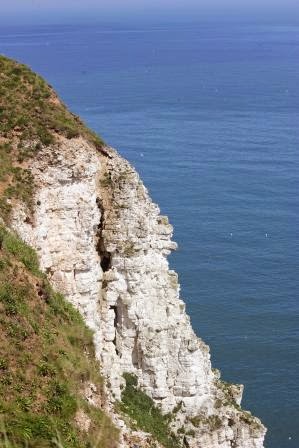
is a spectacular reserve for seabirds. The cliff ledges packed with nesters,
down 300 metres, far below the sea crashed against the rocks, yet more birds,
feeding, gathering...the noise, the calls, the cries…the smell, guano, well what
do you expect, this is a seabird colony of thousands.
The
reserve footpaths meander through large areas of pretty heath land along the
cliff tops,
home to all kinds of wildflowers such as pink thrift, sea campion,
gorse, wild thyme, birds foot trefoil and horseshoe vetch.
 |
| Silver studded blue |
From
the lower car park we headed straight for the cliff tops, we were treated to
flights of butterflies along the way, painted ladies danced with
silver-studded blues , the latter being a
speciality of the reserve. A stonechat couple perched obligingly on the
topmost branches of spiky gorse, comely to the eye and always a pleasure to
see. This habitat is perfect for smaller birds, rock and meadow pipits,
wrens, linnets and skylark’s conspicuous by their calls and manners.
Approaching
the cliffs we observed gannets, wings folded back, plummeting into the sea,
guillemots, razorbills and puffins incoming, silvery sand eels grasped tightly
in beaks.
 |
| Guillemots |
We
sat near Ellin’s tower. Observing the squabbling, jostling auks. Up to 4,000
breeding guillemots and 700 razorbills, squashed together on narrow ledges.
Rock pipits flitted around the rocks below before flying up to the grassier
areas and headland where they nested.
A loud ringing 'che-oww' call, alerted us to 3 choughs (9 breeding pairs on site) on
the grassy headland, splendid bright
red, slightly curved bill and red legs - complete with `ringers’ colour
bands.
They sat awhile before swooping and diving in a game of chase, out of
sight.
 |
| Chough |
(Did
you know, in Cornish legend and it
is said that King Arthur was transformed into a chough when he died, the red
feet and beak representing his violent, bloody end)
We moved on, towards the steps leading down to the South
Stack Island and the Lighthouse. We
didn't need to go all the way down, just far enough to see the other side of
the cliffs, and here are quarry was found; puffins, Comical parrot-like,
waddling around their burrows on bright orange legs. We counted at least 7,
were told there are about 20.
 |
| Puffins and Razorbill |
Looking towards the lighthouse grounds, snug amid the daisies
we could see lots of nesting gulls, herring, lesser and greater black backed
and black headed.
On the way back to the café for our obligatory cake and
coffee , some of us were delighted to see a rock pipit family, close to the path, vigilant yet un- perturbed by the mesmerized
watchers, as we observed the parents, beaks crammed full of insects and grubs
return to their hidden nestlings in the heath.
 |
| Rock pipit |
Sadly we dipped on the recently reported peregrines with
their newly fledged chick
Next
stop Cemlyn lagoon for terns, shearwaters and tysties.
 |
| Cemlyn shingle spit |
Cemlyn
run by the wildlife trust is a safe haven for breeding terns. The shallow lagoons
of Cemlyn are separated from the sea by a curving shingle spit protected by wire and wardens.
An astonishing
place, on first impression, visually captivating,
vocally clamorous and then you realise how incredibly close you
can get to the birds without disturbing them. This is one to the
largest sandwich tern colonies in the UK with 2567 pairs breeding this year
–warden survey 2014. Here the elegant sandwich terns return from wintering in
the warmer climes of West Africa to nest
each summer on a series of islands on Cemlyn lagoon; they are joined by 73 Common Tern, 36 Arctic Tern and
370 Black headed Gull nests, and a single rare Roseate Tern.
 |
| Sandwich Tern |
 |
| Families |
So
many babies a joy to see, fluffy tern babies begging adults for fishy dinners. Parent
birds swooping over the heads of the watchers on the shingle spit, beaks full of
sand eels yet still able to call and announce their arrival to their awaiting mates
and chicks!
On a sunny afternoon this truly was a place to tarry a while, to
rest up and sit amongst the multi coloured stones, close your eyes and listen, and
glory in the cacophony. For others came a chance to re-discover a long lost childhood skills of skimming pebbles across the
waters!
 |
| Incoming sand eel dinner |
Away from the spit a footpath from the car park takes you to
the beach, here you can look
out to sea towards the Skerries and the isle of West mouse.
 |
| Towards west mouse |
 |
| Meadow Pipit |
Along the path a bold meadow pipit flew back and
forth around the gate, a nest nearby perhaps?
 |
| Seal |
Scanning
the waters we located some grey seals, basking on a rocky outcrop or bobbing about
as is their nature.
 |
| Merganser |
A female red breasted merganser splashed near to the beach,
whilst oystercatchers piped as they scurried over the rocky shore.
But we were
here for a purpose, we were looking for Manx shearwaters, and they obliged, far
out to sea, skimming across the waters. Id insight - a flying cross -
wings at right angles to the body, changing from black to white as the black
upperparts and white undersides are alternately exposed.(Did you know - It
is the longest lived bird in Britain, with one living at least 55 years.)
Other
sought birds for the day, were tysties or black guillemots, again these were found
out to sea their pure white patches on their black wings giving them away.
Time
for home, mission accomplished, another grand day out.
Laura
Pics: N Prendergast/L Bimson