Holidaying for the first time on the
North Yorkshire coast and being unfamiliar
with the area left me wondering how much bird life I might encounter. I need not have worried. I had amazing experiences at two contrasting
sites.
The first visit was to Filey Dams
Nature Reserve. This is a small wetland
site managed by the Yorkshire Wildlife Trust.
It comprises freshwater lagoons surrounded by marsh and grassland grazed
by cattle. It is the largest remaining
freshwater marsh in the region. The
reserve is approached through an estate of bungalows not giving a clue to the
gem that lies behind it.
 |
| Filey Dams: Bur-Marigold pond [Pic: Jones] |
The reserve has
two hides with a wheelchair accessible screen adjacent to one hide.
The first hide revealed Moorhen, Coot,
Canada Geese,
Mallards and Tufted Duck on the first pool. The second hide (not accessible
to wheelchair users) is the East Pool Hide.
The word had gone round that a Curlew Sandpiper had been seen that
morning, but it remained steadfastly hidden while I was there. However, we were treated to excellent views
of two Common Terns. One gave a
delightful exhibition of flying, diving, catching a fish – which it promptly
dropped – and then retrieving same. The
bird life at this hide was a little thin, but I suspect this reserve comes into
its own in autumn. Midway between both
hides is the Bur-Marigold Pond where there is a pond dipping platform. This made for a peaceful moment’s rest where
we were serenaded by the healthy populations of Tree Sparrows. On our return to the car park we were
delighted to see a newly fledged Tree Sparrow sitting on top of a nest box
looking for all the world as if it was saying, “What do I do now?” You can read more about the reserve at http://www.ywt.org.uk/reserves/filey-dams-nature-reserve.
The second and most spectacular site
was RSPB Bempton Cliffs, located midway between Filey and Flamborough Head. What a jewel this site is. Our experience was helped by good weather,
but I doubt that much can detract from the wonders of Bempton at this time of
the year. It presents a real onslaught
on the senses: the sights, sounds and smells are spectacular. More than 200,000 birds inhabit the imposing chalk
cliffs.
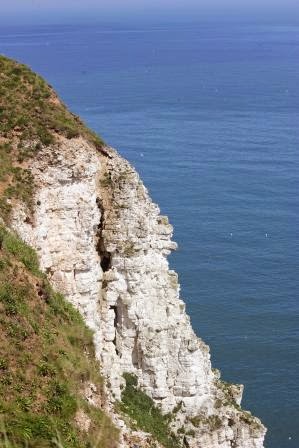 |
Chalk cliffs, Bempton
[Pic:Jones} |
At first the sight is
challenging; it is difficult to appreciate just how many birds are perching
precariously on the cliffs and how many more are in the sea below.
 |
Gannets and guillemots nesting,
Bempton Cliffs [Pic: Jones} |
The balletic movement of Gannets, Guillemots,
Razorbills, Kittiwakes, and Herring Gulls was mesmerising and all achieved
without any choreography. How do they
avoid bumping into each other? Convoys of Gannets patrolled along the seascape
while Puffins performed their clumsy flight as they headed for footholds on the
cliffs. All species were nesting on the
cliffs. It doesn’t take much to realise
that 200,000 birds produce plenty of guano and the smells were witness to that!
 |
| Razorbills, Bempton Cliffs [Pic:Jones] |
The
RSPB team does much to educate at this site with regular Puffintasia events and
Puffin and Gannet Seabird cruises around the cliffs. Boards are dispersed around the site
encouraging visitors to reflect on different elements of Puffin ecology.
No description or photograph can do justice
to this site. Apart from the bird
cornucopia, there is a wealth of wildflowers, invertebrates and soils. This site is a must to visit if you have the
slightest interest in seabirds and their ecology.
 |
| Education board [Pic: Jones} |
 |
Well surfaced paths are feature of
main access areas at the reserve [Pic: Jones} |
Accessibility for wheelchair users is
satisfactory at this site, but access to southerly viewpoints would be
challenging for users of non-motorised wheelchairs
Further information about RSPB
Bempton Cliffs can be found at: http://www.rspb.org.uk/reserves/guide/b/bemptoncliff


