Showing posts with label puffins. Show all posts

Sunday, 14 June 2015

Anglesey again, Penmon and Puffins


Bobbing along - Puffins from Puffin island

Another sunny day saw Bill and I back on Anglesey. This time we decided to do a stretch of the coastal path from Beaumaris to Penmon point and back, a walk of nine miles. A walk with a twist, we decided to include a boat trip from Beaumaris pier to Puffin Island.
Beaumaris is a pleasant seaside town with its own medieval castle. Popular with day-trippers and today was no exception. On a clear sunny day the view along the menai straight is fabulous, a panoramic views over the waters to the Snowdonia Mountain Range, Abergwyngregn and Llanfairfechan.
View from Beaumaris

We climbed aboard our boat- the island princess http://www.starida.co.uk/ (Boat trips £9.00) the 11.30am boat was full including 5 well behaved dogs on board! The trip takes 75 mins and fortunately for all onboard the weather was great, sunny, light winds and not too much of a swell on the sea.
Puffin Island (Ynys Seiriol in Welsh) is uninhabited and is designated a Special Protection Area on account of its large cormorant population over 750 pairs, making it one of the largest colonies in the British Isles. A fabulous, beautiful sanctuary, free from humans disturbance, and land predators such as fox, stoat or rats. The rats were eradicated in 1998 - 2000 using tonnes of warfarin, brought to the island by boat and with the assistance of RAF Valley helicopter Squadron. The rats used to feast on eggs and chicks during the short breeding season, decimating the puffin, today the Scan team report 30 breeding pairs being a high estimate. http://www.puffinisland.org.uk/news/kittiwakesandatokenpuffin
Puffin Island is the ninth largest island off the coast of Wales. It is carboniferous limestone, and has steep cliffs on all sides. Its highest point is 190ft above sea level and it covers an area of 69 acres. 

Puffin Island
As we approached the island, the usual cacophonies of a seabird colony met you ears, but fortunately unlike Bempton and Farne not close enough to be nasally assaulted by guano and regurgitated fish paste.
Puffin Island is home to breeding populations of at least 12 species of seabird in their natural habitat – guillemot and black guillemot, cormorants, kittiwakes, fulmar, razorbill, shag, cormorant,  and of course the puffin. Herring, lesser black backed and gtr black backed gulls. If you’re fortunate you may also get to see gannets, chough, raven, peregrine falcons and storm petrels.
Nesting colony

Gulls
Kitiwakes
Cormorants

Guillemots


The east end of the island is home to a colony of grey seals which can be seen swimming in the sea or basking on the beach, as you can see rather chilled out.
Lifes' a beach- Grey Seals on Puffin island shore

Returning to Beaumaris the attentive skipper pointed out puffins bobbing about on the sea and a harbour porpoise off the bow of the boat. Note: those wanting a longer stay can join the Extended Wildlife & Sightseeing Cruise or 2hr photographers cruise.

Razorbill & Guillemot

                            
Back on terra firma we set out on our walk following the coastal path, we have maps but, the way is marled by blue discs and generally well marked.
A lot of the walk to Penmon point is done over the beach or should I say pebbles/shingle, so a warning is required as this can be hard going and will extend your walking time; make sure you have the right footwear. 
Ringed plover pair
On the plus side, shingle can lead to some welcome bird sightings, all along the way
we observed piping oystercatchers, bathing gulls and a couple of scurrying ringed plover.  At sea along the shore a red breasted merganser and 3 eider ducks.


Whoooo... Eider ducks


Some of the cliffs along the way are striking with caves, and interesting strata and most importantly a home for sand martins.
Sand martin nesting bank

Caves


Approaching Penmon priory
Before reaching Penmon point and it's lighthouse you reach Penmon Priory, thought founded by St Seiriol’s in the sixth century.  A peaceful place surrounded by woodland with its own Holy Well, the spring emerges from a cliff behind the church.  It has a dovecot built to house domestic pigeons for their eggs and meat.  Inside were 1000 nesting boxes to accommodate the birds.

There had been reports the week before that someone had heard a corncrake in the priory grounds, no such luck! But lots of more common birds were heard and seen linnets, chiffchaff, willow warbler, blackbird, goldcrest, song thrush, goldfinch, great ,blue and long tailed tit, wren etc

Penmonpoint and a local artist Antony Garratt
 http://www.bbc.co.uk/news/uk-wales-north-west-wales-32164147
 
Penmon Point 

At the end of the road is Penmon point. A picturesque area with lots of rock pools to explore. A fast flowing current flows through the sound that separates Puffin Island from the point (Trwyn Du). In 1837 a lighthouse was built to warn ships of the treacherous waters, in 1832 a lifeboat station was established and served the area between 1832- 1915, saving 116 lives.

Reverse the map and back for tea. So there you go a wee blog on somewhere very nice to go for the day.
 Laura

Saturday, 25 April 2015

Help us create a safer home for seabirds on the Shiant Isles.

JUST 51 PENCE CAN MAKE A SQUARE METRE SAFER FOR SEABIRDS ON THE SHIANTS, in total there are 2,200,000 square metres to be cleared of rats.
Puffins and Razorbills Shiants - RSPB image J Richardson

Situated in the stormy seas off the Outer Hebrides, the Shiants are a noisy, sea-salty breeding ground in the Atlantic where seabirds raise their young.
The isles are already home to 10 per cent of the UK population of puffins, and seven per cent of our razorbills.
But there could be many, many more.
Year after year, significant numbers of Shiant Isle seabird chicks are killed by non-native black rats.
Black rat
But with your help we'll remove the rats for good so that the full potential of the islands' seabirds can finally be realised.

What we'll be doing

With your support we can restore and secure seabird populations on these amazing islands.
We aim to remove the rats in time for the summer 2016 seabird breeding season and every one after that. 
The entire project will cost £1.13 million and we have secured 70 per cent of the total cost from the EU LIFE+ fund, Scottish Natural Heritage and major private donors to the RSPB.
But your support is critical to get us over the finish line. We need £345,000 before 18 May this year to get to work.
Fortunately, we don't have to imagine the impact of removing rats from the isles as we've witnessed similar projects around the UK and the globe. Likely consequences include:
A dramatic benefit to seabird populations. The populations of puffins, razorbills, guillemots and shags - species struggling around the UK - will raise more chicks. Removing the rats from the island of Lundy, off the coast of Devon, saw Manx shearwater numbers increase tenfold and there are now four times as many puffins.
The return of Manx shearwaters to the islands. We've found Manx shearwater bones on the Shiants, which strongly indicates that they once bred there. But they simply won't return as long as the rats remain. We have to remove the rats now, or Manx shearwaters and other species like storm petrels will never come back.
A significant boost for the islands' small populations of other ground-nesting birds. Twites, oystercatchers, skylarks, wheatears and curlews should also benefit once they can breed safe from rat predation. Your donation will help secure their future.
After studying all the options, specialists concluded that the only safe and effective way to eradicate the rats is to lay poison in bait stations around the islands for them to consume. The operation will take place in winter, when the rat population is at its lowest and most of the seabirds are away feeding at sea. Careful measures will be used to reduce the risks to all the other wildlife on the islands.
By next summer the rats should be gone. But our project will continue for another three years, doing all we can to stop rats returning; monitoring how the seabirds fare in their safer island home and encouraging species like Manx shearwaters to return.
Can you help us save the seabirds of the Shiant Isles?

Copy and paste link
https://www.rspb.org.uk/applications/donations/single/index.aspx?dt=APLITH0653

Thursday, 5 June 2014

Little and large in Yorkshire

Holidaying for the first time on the North Yorkshire coast and being unfamiliar with the area left me wondering how much bird life I might encounter.  I need not have worried.  I had amazing experiences at two contrasting sites.
The first visit was to Filey Dams Nature Reserve.  This is a small wetland site managed by the Yorkshire Wildlife Trust.  It comprises freshwater lagoons surrounded by marsh and grassland grazed by cattle.  It is the largest remaining freshwater marsh in the region.  The reserve is approached through an estate of bungalows not giving a clue to the gem that lies behind it.  
Filey Dams: Bur-Marigold pond [Pic: Jones]
The reserve has two hides with a wheelchair accessible screen adjacent to one hide.  The first hide revealed Moorhen, Coot, Canada Geese, Mallards and Tufted Duck on the first pool.  The second hide (not accessible to wheelchair users) is the East Pool Hide.  The word had gone round that a Curlew Sandpiper had been seen that morning, but it remained steadfastly hidden while I was there.  However, we were treated to excellent views of two Common Terns.  One gave a delightful exhibition of flying, diving, catching a fish – which it promptly dropped – and then retrieving same.  The bird life at this hide was a little thin, but I suspect this reserve comes into its own in autumn.  Midway between both hides is the Bur-Marigold Pond where there is a pond dipping platform.  This made for a peaceful moment’s rest where we were serenaded by the healthy populations of Tree Sparrows.  On our return to the car park we were delighted to see a newly fledged Tree Sparrow sitting on top of a nest box looking for all the world as if it was saying, “What do I do now?”  You can read more about the reserve at http://www.ywt.org.uk/reserves/filey-dams-nature-reserve.

The second and most spectacular site was RSPB Bempton Cliffs, located midway between Filey and Flamborough Head.  What a jewel this site is.  Our experience was helped by good weather, but I doubt that much can detract from the wonders of Bempton at this time of the year.  It presents a real onslaught on the senses: the sights, sounds and smells are spectacular.  More than 200,000 birds inhabit the imposing chalk cliffs. 
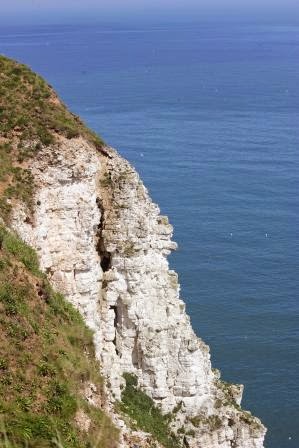
Chalk cliffs, Bempton
[Pic:Jones}
At first the sight is challenging; it is difficult to appreciate just how many birds are perching precariously on the cliffs and how many more are in the sea below.  
Gannets and guillemots nesting,
Bempton Cliffs [Pic: Jones}

The balletic movement of Gannets, Guillemots, Razorbills, Kittiwakes, and Herring Gulls was mesmerising and all achieved without any choreography.  How do they avoid bumping into each other? Convoys of Gannets patrolled along the seascape while Puffins performed their clumsy flight as they headed for footholds on the cliffs.  All species were nesting on the cliffs.  It doesn’t take much to realise that 200,000 birds produce plenty of guano and the smells were witness to that!  

Razorbills, Bempton Cliffs [Pic:Jones]

 The RSPB team does much to educate at this site with regular Puffintasia events and Puffin and Gannet Seabird cruises around the cliffs.  Boards are dispersed around the site encouraging visitors to reflect on different elements of Puffin ecology. 

No description or photograph can do justice to this site.  Apart from the bird cornucopia, there is a wealth of wildflowers, invertebrates and soils.  This site is a must to visit if you have the slightest interest in seabirds and their ecology.  

Education board [Pic: Jones}


 Well surfaced paths are feature of
main access areas at the reserve [Pic: Jones}
Accessibility for wheelchair users is satisfactory at this site, but access to southerly viewpoints would be challenging for users of non-motorised wheelchairs

Further information about RSPB Bempton Cliffs can be found at: http://www.rspb.org.uk/reserves/guide/b/bemptoncliff


Friday, 8 June 2012

Five go to Anglesey


Our Mission

To explore what Anglesey has to offer, to see 60 (diamond jubilee) different species of birds, to eat plenty of cake and have a jolly good time.

We managed to pick the best day of the long weekend for our trip to Anglesey.  The sun was shining but it was not too hot to spoil our enjoyment of the day.

We headed straight for South Stack RSPB reserve which is home to thousands of seabirds, in particular Guillemots, Razorbills, Kittiwakes with a few Puffins and Choughs.  No sooner were we on the coastal path we had close views of a stunning pair of Stonechats and a Skylark displaying.  Wild flowers were in abundance and the views across the bay were beautiful.  We made our way to Ellins Tower visitor centre where they had cameras on some Razorbills and a Chough’s nest.  We were lucky enough to see one of the adult birds bringing food in to the nest and the chicks being fed.  Wanting to see these ourselves we made our way down the steps towards the lighthouse to get a view of the nest which was situated in a cave in the cliffs.  Although we gave this some time, we didn’t see the adults returning to the nest but got better views of the Puffins and a Rock pipit.  After some refreshment and before leaving the site we had a quick scan of the nearby fields where the Choughs are known to feed in the short grass but to no avail.  On our way back to the car Ron and Anne P spotted a pair of Choughs flying across the bay and although we were unable to hear their distinctive call we were in no doubt as to what we had seen.


Next stop lunch and Ann (Tomo’s) cake.  We headed back to Holyhead Harbour and stumbled across a country park which we thought might be a good place to picnic.  We picked up a few of the more common species here around the lake and watched a large (12-13lb) ghost Carp being landed by a fisherman.  Well some of us did.

Moving on our next port of call was Holyhead Harbour/Soldiers Point.  We walked along a tree lined lane passing fields and a large former MOD building, moving a fledgling Wren off the road on our way.  At the end of the lane you reach the sea and the harbour walls.  A few House martins and a couple of Sand martins were fly catching over the sea and a pair of Linnets were seen briefly perched on a boulder.  The highlight here though were close views of a Ringed plover with two chicks in tow, the parent trying to distract us by using diverting tactics.  Then on our way back one of the adult birds appeared on the path just a few metres away and seemed totally unperturbed by our presence.

Time to head on to our next destination, RSPB Valley Wetlands.  Fortunately, a street party which had closed the road further up did not prevent access to this site.  Here we picked up a few ducks and geese, the surprise being a Barnacle goose which was hanging around with a couple of Canada geese.  Here, Anne (Pope’s) granddaughter’s  jubilee cakes were consumed and enjoyed.


Time was pressing on and we headed down the A5 to Malltraeth Cob Pool stopping briefly at Llyn Parc Mawr where the highlight was a Little grebe sitting on a nest on the lake and her partner bringing her food (or was it nesting material).  On to Cob Pool and we clocked up our last few birds of the day, Little Egret, Heron, Mistle Thrush and Whitethroat.

The total number of birds seen on the day was 61 with only one of these being seen on the mainland.

Time to go home, mission accomplished and thanks to Ron for his excellent driving.

Jay
Chough
Ringed Plover
Skylark
House Sparrow
Robin
Stonechat
Collared Dove
Chaffinch
Guillemot
Mallard
Canada Goose
Herring Gull
Moorhen
Tufted Duck
Lesser Blck Bk Gull
Great Tit
Coot
Cormorant
Blue Tit
Mute Swan
Fulmar
Willow Warbler
Greylag Goose
Swallow
Starling
Pochard
Kittiwake
Woodpigeon
Black Headed Gull
Razorbill
Buzzard
Gt Black Bk Gull
Pied Wagtail
Kestrel
Swift
Meadow Pipit
Dunnock
Barnacle Goose
Puffin
Chiff Chaff
Little Grebe
Rock Pipit
Greenfinch
Teal
Carrion Crow
Oystercatcher
Little Egret
Rock Dove
Wren
Mistle Thrush
Jackdaw
Magpie
Grey Heron
Shelduck
House Martin
Whitethroat
Blackbird
Sand Martin

Goldfinch
Linnet


  Ann Thomson