Showing posts with label hen harriers. Show all posts

Friday, 20 November 2015

Nature Summit: EU officials to consider future of Lancashire special places

UK sites affected could include Forest of Bowland and Leighton Moss
Campaigners from across Europe, including the UK, are arriving in Brussels to tell the European Commission to drop the attack on vital nature laws and focus on their enforcement instead.
Today’s discussions have particular relevance for Lancashire as the future of special sites, such as the Forest of Bowland and Leighton Moss and key species including hen harriers and bitterns are protected under the Nature Directives.
Conservationists, including the RSPB’s Chief Executive, politicians and representatives of the EU institutions are today [Friday 20th November] attending the “Conference on the Fitness Check on EU Nature Legislation” organised by the European Commission in Brussels as part of the review of the Birds and Habitats Directives: collectively known as the Nature Directives.
EU Environment Commissioner, Karmenu Vella, will outline the Commission’s first findings from the process so far. The Commission consultants will outline their findings from the biggest ever detailed evaluation of nature conservation legislation in Europe. The results, which included over half a million responses from citizens across the European Union concerned about threats to the Nature Directives, will be discussed by panels composed of officials from Member States, industry and farmers’ representatives, conservation organisations and MEPs.
It’s feared the Fitness Check, which is part of the Commission ‘REFIT’ agenda, of the laws could be used as an excuse to re-open and potentially weaken these laws under the guise of ‘better regulation’. But since the review began, the people of Europe have demonstrated an unprecedented show of support to protect nature.
A record number of people took part in a public consultation on this issue in the summer, with the overwhelming majority of the more than a half a million who responded backing the directives and asking for stronger implementation.
Last month, environment ministers from nine EU countries, including Germany, France and Spain – but not the UK - signed a letter to the Commission calling for the laws to be better implemented, not weakened. In the same week, an equally supportive letter followed from MEPs representing the seven biggest political groupings in the European Parliament.
A European Parliament draft report on the EU’s Biodiversity Strategy, presented earlier this month, also highlighted the importance of protecting the Nature Directives.
Mike Clarke is the RSPB’s Chief Executive. He said: “At a time when nature is facing an extreme crisis, the Fitness Check evidence has shown, unequivocally, that the Nature Directives not only work but they are the strongest tool Europe has to prevent further erosion of nature. The evidence proves it makes no sense to undermine the Nature Directives. It is also clear that problems, such as poor and uneven enforcement, lack of funding and the impact of measures like the Common Agricultural Policy are responsible for driving down populations of threatened wildlife.”
Campaigners from the conservation organisations behind the Nature Alert campaign to protect the directives (BirdLife Europe, EEB, Friends of the Earth and WWF) will be raising awareness outside the event and will also be represented amongst the speakers.
The European Commission’s decisions on the future of Nature Directives is expected by June 2016.

Tuesday, 25 November 2014

Skydancers on the Dee


Visitors to the RSPB’s Parkgate reserve on the Dee Estuary are being given the chance to see England’s most threatened bird of prey in action.

The reserve is hosting Skydancers on the Dee, a series of monthly events offering nature lovers the opportunity to experience hen harriers at their winter roost site.

Hen harriers breed in the uplands and are famous for the male’s spectacular aerobatic spring courtship display known as skydancing. The birds spend the winter on lower ground, often on marshes, and the Dee Estuary has long been one of the best places to see these remarkable birds.

Sadly, hen harriers are on the brink of extinction in England as a breeding bird. This year there were only four breeding pairs in the whole of England. In 2013, there was not a single successful nest in the country, despite scientists concluding there is sufficient habitat for more than 300 pairs.

Independent research has shown that ongoing illegal killing and disturbance associated with the grouse moor industry is responsible for the plight of the hen harrier.

Dan Trotman, the RSPB’s Visitor Development Officer on the Dee Estuary, said: “It is a real privilege to be able to see these magnificent birds hunting and roosting on the estuary. I hope that when our visitors see them in action, they will be inspired to help us save them from extinction in England as a breeding bird before it is too late.

“The saltmarsh at Parkgate is where the harriers traditionally roost but they roam some distance during the day to feed; recently we’ve been treated to fantastic views of one, sometimes two, hen harriers hunting close to the reception hide at Burton Mere Wetlands, so it’s well worth a trip there too.”
  
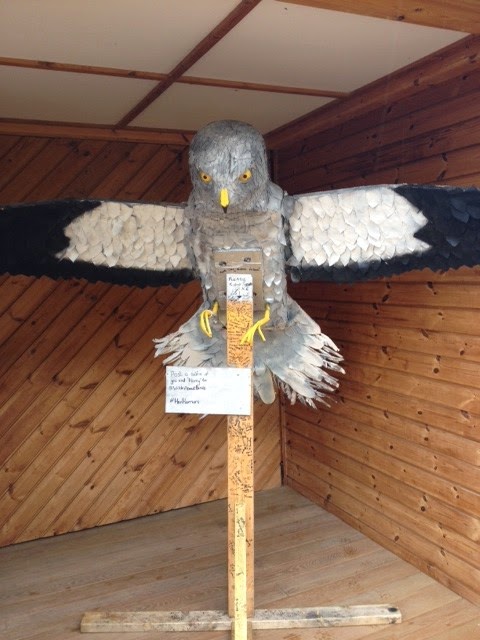
There is also a giant hen harrier spending the winter over at Burton Mere Wetlands. Harry is a six-foot male hen harrier, created by local young nature enthusiast Findlay Wilde. The large-scale model bird has been touring the country to raise awareness about hen harrier conservation. This year, it has made appearances at Hen Harrier Day in the Peak District, Bird Fair in Rutland and mostly recently, on BBC Autumnwatch at RSPB Leighton Moss in Lancashire.

Skydancers on the Dee is on Sunday 30 November from noon until dusk, at the “Donkey Stand” on The Parade in Parkgate. There are further events on 21 December 2014, 25 January 2015, 22 February and 29 March. All events are free and visitors can drop in any time. 

Skydancers on the Dee is part of Skydancer, a four-year RSPB project aimed at protecting and conserving nesting hen harriers in the English uplands. The project is funded by the Heritage Lottery Fund and United Utilities with additional support from the Forestry Commission. For more information, visit www.rspb.org.uk/skydancer


Thursday, 30 October 2014

A bad apple can spoil everything

Know a bad apple?

Take the bloke who thinks it's okay to kill birds of prey.
Maybe you know him.
He might even be someone who tells you it's part of the job. He understands that killing protected wildlife is illegal. He's aware that it drags the good name of gamekeeping through the mud.
But who will end up in court, possibly prison, when it all goes wrong? He'll watch his own back. It's unlikely he'll be watching yours.
If you have any information about the illegal killing of birds of prey, call the RSPB's confidential hotline on 0845 466 3636*.
Together, we can make a stand for what's right.
* Calls to this number are not recorded and will be treated in strictest confidence.
We know that some people are pressurised into illegally killing birds of prey. We hope this hotline will encourage anyone with knowledge of such crimes to come forward and help us end the killing.

How you can help

The hotline telephone number above is intended as a confidential method for gamekeepers and other people connected with the shooting industry to report offences against birds of prey. For more general enquiries please click on the link below.

Thursday, 25 September 2014

Gone Girls: Threatened birds of prey disappear without trace

Hope

Two young satellite-tagged hen harriers have vanished in Lancashire in unexplained circumstances. 

The female birds, named Sky and Hope, both fledged this year from nests on the United Utilities Bowland Estate in Lancashire where they had been protected around the clock by RSPB staff and volunteers.

Hen harriers are England’s most threatened bird of prey and this season there were only four successful nests in the whole country. Sky and Hope were among the first chicks to fledge in England since 2012.

Sky was officially named and adopted by pupils from Brennand’s Endowed Primary School in Slaidburn in Bowland. Hope was given her name by members of the RSPB’s youth groups from Macclesfield and Leighton Moss, Lancashire.  

The birds were both fitted with lightweight solar-powered satellite tags, designed to be operational for around three years. Satellite tags are frequently used by conservation organisations to find out more about the movements of species. For example, The British Trust for Ornithology has been following the migration of tagged cuckoos since 2011.  

Scientists tracking the movements of the young hen harriers became concerned when their tags stopped transmitting. Sky’s satellite signal stopped suddenly on the evening of Wednesday 10 September with the data suggesting she was roosting at her last known location, while Hope’s last’s known location was sent on the morning of Saturday 13 September. 

Both of the birds had left their nest sites on the United Utilities Estate several weeks earlier but had remained in the Bowland area since fledging. Searches were made but neither Sky nor Hope have been recovered.

Experts think it is improbable that the loss of satellite transmission is due to technical failure. Only a tiny percentage of hen harriers fitted with satellite tags since 2007 have stopped transmitting when it was known the tracked bird was alive.
Bob Elliot, RSPB Head of Investigations, said: “In our experience, this satellite technology is normally very reliable and it is rare for them to fail for technological reasons.  Losing two birds in such a short time frame and in the same geographical area is strange.

“Based on the last known data and our understanding of the technology, Sky appears to have suffered a catastrophic tag failure at roost suggesting either natural predation or human intervention as the likely causes for her sudden failure to transmit. However, we would not expect natural predation to stop the tag transmitting data so suddenly. Hope’s tag was transmitting reliably, with no evidence of any technical problems.”

TV presenter and hen harrier campaigner Chris Packham said: “It’s incredibly disheartening to discover that two of this year’s chicks have already apparently failed to survive. It shows how vulnerable hen harriers are and that four nests are nowhere near enough. Without satellite tagging, these disappearances might never have come to our attention but technology is on our side and we will keep watching.”
Sky


The disappearance of the birds has been reported to Lancashire Police and the RSPB is offering a £1,000 reward. Anyone with information about either of the birds should contact  
Crimestoppers on 0800 555 111 or, alternatively, call the RSPB’s confidential hotline on 0845 466 3636.


Sunday, 21 September 2014

More Welsh wanderings and scrambling


Newborough Warren
Sometimes I think I’m in a dream, sauntering along on a sunny day, singing skylarks overhead, the kronking of raven on the headland, chough chi-owing along cliff faces, even the roar of the overhead jets add to the sensory delights of stunning Anglesey. Heady thoughts of retiring to a rural cottage, watching the seasons unfurl, away from the hustle and bustle of cities….mmh

So here we are again  ’Another balmy, sunny day, another place on Anglesey; this time we’re in bunnyland, well that was what  Newborough warren had been famous for ( as over 100,000 rabbits a year were taken from the warren by the residents) although on the day we only saw one from the path, I’m sure there were lots more about, as one of the first things we saw on the sandy path was a particularly fit looking stoat crossing into the warren, plenty of dinners to be had here it would seem.

Today’s circular walk starts and ends at the lake of Llyn rhos du and incorporates a walk through the Corsican and Scots pines of Newborough forest and a visit to this isle of llanddwyn.
Sandy paths

Newborough Warren is part of a National Nature Reserve, which also includes Llanddwyn Island- the sacred blessed isle of St Dwynwen’s.(Welsh patron  saint of lovers! - Nothing wins hearts like cheerfulness - St. Dwynwen)
To the left of the path is the reserve of newborough warren, it’s a massive dune system with a freshwater lake, saltmarsh, mudflats, a long beautiful beach and stunning views of the sea and Snowdonia
Lyn rhos du

Starting at Llyn rhos du’s car park,  a quick look over the freshwater  lake from the new bird hide only revealed coot, little grebe and swooping swallows.
A small herd of white Welsh mountain ponies were grazing on the warren - used to keep the sward in the condition needed by the wild plants that grow there. The song of Skylarks, robin, wren and Meadow Pipits could be heard. A kestrel hovered over the dunes.
The dunes are also home to toads and lizards, confirmed as a sand lizard dashed across our path and a young toad narrowly escaped being trodden on, a case of eyes to the path not to the skies! 

The beach at Newborough is long and sandy, and obviously popular with the locals. Extensive stunning views over to Snowdonia are afforded here. We continued along the beach to LLanddwyn Island passing some of the oldet rocks on Anglesey along the way. The island is more a long thin peninsula that gets cut off from the mainland only on the highest tides- not marooned today!
St Dwynwen's cross  and lighthouse

An atmospheric, serene little place, with its chapel ruins and beacons.
Chapel ruins
There are two beacons/lighthouses built at the tip of the island Tŵr Bach & Tŵr Mawr. The former lighthouse now returned to service after a modern light was placed on top. Off the tip of the island there were some rocky outcrops/islands, cormorants and gulls were sunbathing. On an inlet beach, a party of gulls were squabbling mainly adult and young herring gulls. Two oystercatchers were on the rocks nearby. Three sandwich terns were careering over the sea close to shore. As we walked along the island path, smaller residents were conspicuous, rock pipit and stonechat. A solitary wheatear was popping around the ruined chapel field.
We stopped for lunch on a promontary, fabulous.
Newborough view from island

Tall Pines
Leaving St Dwynwen’s resting place behind us we headed back to the path leading into the forest. This be the home of Red Squirrels, and we were lucky enough to see one shortly after, scampering up a pine too quickly for my camera - by the way don't forget to vote for Bob! https://www.voteforbob.co.uk/

Apparently Newborough forest has a large raven roost, none heard or seen, far too early in the day. However we did see jays and buzzards as the path opened up to the estuary of the afon cefnii - one buzzard having no luck being mobbed by 4 crows! Curlews were calling on the estuary, but here our path turned away, back to Lyn Rhos du - we shall save Malltreath for another day. http://www.rspb.org.uk/discoverandenjoynature/seenature/reserves/guide/m/malltraethmarsh/index.aspx
Estuary Afon Cefnii, Malltreath

There are interpretation boards along the nature reserve path and trail markers throughout. Good, well-defined paths and the going is generally easy.

The following day saw us back in Wales, but this time in Snowdonia. Our aim was to climb the shapely magnificence that is Moel Siabod (2,860 feet) A mountain that looms large above coniferous forests near to Capel Curig.  On a clear day, the summit offers a fine panorama, revealing part or all of the highest three mountain ranges in Wales. Unfortunately although the day had dawned warm and windless September’s mist hung heavy and we could only just make out Snowdon and Tryfan through the haze as the day waned.
A spectacular start to our walk occurred as a fabulous male hen harrier glided over the heather clad moor and flanks of the mountainside, a Skydancer, ecstatic to see this special bird. http://www.rspb.org.uk/joinandhelp/donations/campaigns/hen-harrier-appeal/index.aspx


On the route we saw pied wagtails, buzzard, kestrel, robin, goldfinch, m pipit, skylark, wren and stonechat. As we approached the summit another highlight two splendid ravens kronked over the trigpoint, alas gone by the time the weary arrived.
Bill & laura on the summit
Anyone considering the walk should 
know it can involve a scramble up the ridge dependant on the path taken to the summit, amazingly didn't seem to stop the sturdy, foot sure sheep...

Late cuckoo with caterpillar

One more treat for the day - the path down 
the back of the mountain led us through a dip leading into the forest. A beautiful area, colourful, rowan trees heavy with berries, grasses thick and swaying and home to a particularly large black, hairy caterpillar that was about to become lunch for a cuckoo, a late cuckoo, no doubt taking advantage of the warm September weather before making it’s long journey to Africa.
Cuckoo path


Another fine day out, followed by tea in the Glan Aber , Betws y coed an old haunt of ours, still serving great pies after twenty years! 

Laura