Showing posts with label skydancers. Show all posts

Tuesday, 25 November 2014

Skydancers on the Dee


Visitors to the RSPB’s Parkgate reserve on the Dee Estuary are being given the chance to see England’s most threatened bird of prey in action.

The reserve is hosting Skydancers on the Dee, a series of monthly events offering nature lovers the opportunity to experience hen harriers at their winter roost site.

Hen harriers breed in the uplands and are famous for the male’s spectacular aerobatic spring courtship display known as skydancing. The birds spend the winter on lower ground, often on marshes, and the Dee Estuary has long been one of the best places to see these remarkable birds.

Sadly, hen harriers are on the brink of extinction in England as a breeding bird. This year there were only four breeding pairs in the whole of England. In 2013, there was not a single successful nest in the country, despite scientists concluding there is sufficient habitat for more than 300 pairs.

Independent research has shown that ongoing illegal killing and disturbance associated with the grouse moor industry is responsible for the plight of the hen harrier.

Dan Trotman, the RSPB’s Visitor Development Officer on the Dee Estuary, said: “It is a real privilege to be able to see these magnificent birds hunting and roosting on the estuary. I hope that when our visitors see them in action, they will be inspired to help us save them from extinction in England as a breeding bird before it is too late.

“The saltmarsh at Parkgate is where the harriers traditionally roost but they roam some distance during the day to feed; recently we’ve been treated to fantastic views of one, sometimes two, hen harriers hunting close to the reception hide at Burton Mere Wetlands, so it’s well worth a trip there too.”
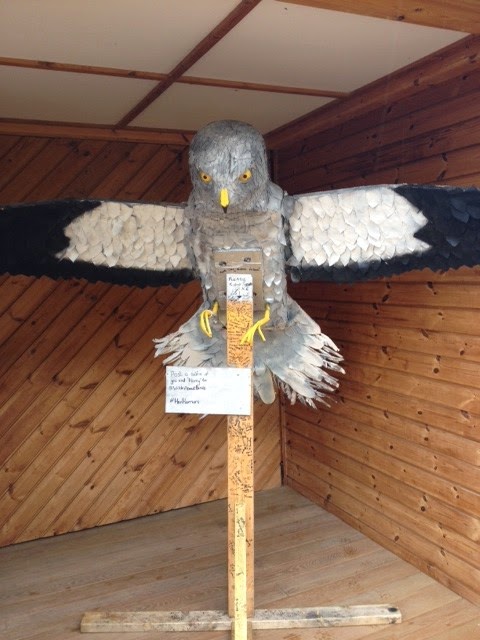
  
There is also a giant hen harrier spending the winter over at Burton Mere Wetlands. Harry is a six-foot male hen harrier, created by local young nature enthusiast Findlay Wilde. The large-scale model bird has been touring the country to raise awareness about hen harrier conservation. This year, it has made appearances at Hen Harrier Day in the Peak District, Bird Fair in Rutland and mostly recently, on BBC Autumnwatch at RSPB Leighton Moss in Lancashire.

Skydancers on the Dee is on Sunday 30 November from noon until dusk, at the “Donkey Stand” on The Parade in Parkgate. There are further events on 21 December 2014, 25 January 2015, 22 February and 29 March. All events are free and visitors can drop in any time. 

Skydancers on the Dee is part of Skydancer, a four-year RSPB project aimed at protecting and conserving nesting hen harriers in the English uplands. The project is funded by the Heritage Lottery Fund and United Utilities with additional support from the Forestry Commission. For more information, visit www.rspb.org.uk/skydancer


Thursday, 25 September 2014

Gone Girls: Threatened birds of prey disappear without trace

Hope

Two young satellite-tagged hen harriers have vanished in Lancashire in unexplained circumstances. 

The female birds, named Sky and Hope, both fledged this year from nests on the United Utilities Bowland Estate in Lancashire where they had been protected around the clock by RSPB staff and volunteers.

Hen harriers are England’s most threatened bird of prey and this season there were only four successful nests in the whole country. Sky and Hope were among the first chicks to fledge in England since 2012.

Sky was officially named and adopted by pupils from Brennand’s Endowed Primary School in Slaidburn in Bowland. Hope was given her name by members of the RSPB’s youth groups from Macclesfield and Leighton Moss, Lancashire.  

The birds were both fitted with lightweight solar-powered satellite tags, designed to be operational for around three years. Satellite tags are frequently used by conservation organisations to find out more about the movements of species. For example, The British Trust for Ornithology has been following the migration of tagged cuckoos since 2011.  

Scientists tracking the movements of the young hen harriers became concerned when their tags stopped transmitting. Sky’s satellite signal stopped suddenly on the evening of Wednesday 10 September with the data suggesting she was roosting at her last known location, while Hope’s last’s known location was sent on the morning of Saturday 13 September. 

Both of the birds had left their nest sites on the United Utilities Estate several weeks earlier but had remained in the Bowland area since fledging. Searches were made but neither Sky nor Hope have been recovered.

Experts think it is improbable that the loss of satellite transmission is due to technical failure. Only a tiny percentage of hen harriers fitted with satellite tags since 2007 have stopped transmitting when it was known the tracked bird was alive.
Bob Elliot, RSPB Head of Investigations, said: “In our experience, this satellite technology is normally very reliable and it is rare for them to fail for technological reasons.  Losing two birds in such a short time frame and in the same geographical area is strange.

“Based on the last known data and our understanding of the technology, Sky appears to have suffered a catastrophic tag failure at roost suggesting either natural predation or human intervention as the likely causes for her sudden failure to transmit. However, we would not expect natural predation to stop the tag transmitting data so suddenly. Hope’s tag was transmitting reliably, with no evidence of any technical problems.”

TV presenter and hen harrier campaigner Chris Packham said: “It’s incredibly disheartening to discover that two of this year’s chicks have already apparently failed to survive. It shows how vulnerable hen harriers are and that four nests are nowhere near enough. Without satellite tagging, these disappearances might never have come to our attention but technology is on our side and we will keep watching.”
Sky


The disappearance of the birds has been reported to Lancashire Police and the RSPB is offering a £1,000 reward. Anyone with information about either of the birds should contact  
Crimestoppers on 0800 555 111 or, alternatively, call the RSPB’s confidential hotline on 0845 466 3636.


Thursday, 31 January 2013

These are OUR Harriers

Harrier at  Parkgate N Prendergast


Read Dan's blog about OUR Hen Harriers!
A half dozen Healthy harriers

Copy and paste links in your search bar

http://www.rspb.org.uk/skydancer/
http://www.rspb.org.uk/community/ourwork/skydancer/default.aspx


The RSPB Dee Estuary reserve is a top wintering site for hen harriers, come and take a look :


Skydancers @ Parkgate

Sunday 3 February  and  Sunday 3 March/.   12 noon until dusk
Skydancer is an exciting new four-year project aimed at raising awareness and promoting the conservation of hen harriers in the north of England.
The Dee Estuary is a vital wintering ground for these amazing birds and is the best place to see them from October through to March
Most people have never seen a hen harrier, but once seen it is rarely forgotten. This bird is a beautiful, agile hunter, and its aerobatic sky dances are among the most awesome spectacles in nature.
Unfortunately, with only a handful of pairs still breeding successfully in England, the hen harrier is currently a species on the brink.
Come along to Parkgate to find out more about the hen harrier story and what you can do to help save hen harriers before it's too late!
Look for the RSPB Love Nature marquee along the main promenade.The "Donkey Stand" opposite Nicholls Ice-cream shop on The Parade (B5135), Parkgate, Cheshire

Laura