Sunday, 30 March 2014


    WORLDS  END.           30.3.14.            very early o'clock !


With the clocks going forward I decided to get up early and try to see the black grouse lek at Worlds End. Sort of meant I could get up an hour later. I know weird logic. Left at 6am, on site by 715am.
I wasn't quite sure where to find the lek but 1 car was parked up when I arrived so just pulled in behind him.

The lek was fantastic......maximum of 12 blackcocks strutting their stuff when I arrived. The noise is incredible. Watched them for the next hour or so. Some really good scraps between some of the birds but mainly lots of strutting and that incredible noise, its got to be one of our greatest wildlife spectacles in this country.

Also loads of meadow pipits, stonechats, tree pipits and wheatear back on territory.

A great morning, and home by 10am.

( pictures not quite up to Neils standard but I hope you like them. )


Sean.


Thursday, 27 March 2014

All change in top 10 for Merseyside

Male House Sparrow

Gardens are vital for many much-loved species. Almost half a million people who took part in this years RSPB Big Garden Birdwatch have discovered some interesting changes among our most popular garden birds, with some species that benefit from a bit of extra help creeping up the rankings.

In Merseyside there were changes in the top ten as house sparrows moved up one position to the top of the table, while the previous occupier of first place, blackbirds, dropped to number three. Starlings also climbed to second place, with an average of two recorded per garden, while blue tits held onto fourth place.

Goldfinches climbed an impressive sixteen places to take seventh position this year and scientists believe that the increase in people providing food, like nyjer seed and sunflower hearts in gardens, may have contributed to their steady rise.
Goldfinch on teasel
Scientists also believe that the weather has played a role in the ups and downs in this year s top ten as many of the birds were recorded in lower numbers in gardens due to the mild conditions. Some species, such as blue tits, were likely to be more reliant on food provided in gardens than others, such as blackbirds, which could easily find their favoured foods like worms and insects in the countryside.

Overall numbers of species such as blackbirds and fieldfares may appear to have dropped in our gardens since last year, but in many cases this is not because these populations are in decline but because these species don t need to come into our gardens during mild winters due to there being plenty of natural food available in the wider countryside.

However the continuing declines of some species are of greater concern.  In Merseyside, numbers of starlings have dropped by 1.2 per cent and song thrushes have dropped by an alarming 94 per cent. Both species are on the UK  red list  meaning they are of the highest conservation concern.
Song thrush

There is slightly better news for the house sparrow, as the declines appear to have slowed, and it remains the most commonly seen bird in our gardens. However, the bird remains on the red list as we have lost 62 per cent nationally since 1979. In Merseyside, the house sparrow claimed first position with an average of two recorded per garden a 2.7 per cent decline compared to last year s results.

Richard Bashford, Big Garden Birdwatch organiser, says:  2014 was always going to be an interesting Big Garden Birdwatch as the winter has been so mild and we wondered if it would have a significant impact on garden birds.

They were out and about in the wider countryside finding natural food  instead of taking up our hospitality. The good news is that this may mean we have more birds in our gardens in the coming breeding season because more survived the mild winter.  It is a great time to give nature a home by putting up a nesting box and supplementary feeding.

Martin Harper, RSPB Conservation Director, says:  Many garden birds rely on us humans for help. During winter, birds need extra food and  water, and at other times of the year, as well as sustenance, a safe place to shelter and make their home can really give them a boost.

Baby Blue tits
Two of the species that moved up the national rankings this year, blue tits and goldfinches, are adaptable, friendly garden birds and great examples of birds that can flourish with our help. If we put up a nestbox, leave out some food or let our gardens grow a bit wild, they ll be among the first to take advantage.


More than 5,500 people in Merseyside took part in the Birdwatch survey in January, which is the largest of its kind in the world.

This year, for the first time, participants were also asked to log some of the other wildlife they see in their gardens. The RSPB asked whether people ever see deer, squirrels, badgers, hedgehogs, frogs and toads in their gardens, to help build an overall picture of how important our gardens are for giving all types of wildlife a home. This information will be analysed and results will be revealed next month.

The Big Schools  Birdwatch is part of the Big Garden Birdwatch. The UK-wide survey of birds in schools has revealed that the blackbird is the most common playground visitor for the sixth year in a row.  85% of schools that took part in the survey in the Big Schools Birdwatch saw blackbirds, with an average of five birds seen per school, slightly down on 2013 figures.

Giving Nature a Home is the RSPB s latest campaign, aimed at tackling the housing crisis facing the UK s threatened wildlife. The charity is asking people to provide a place for wildlife in their own gardens and outside spaces  whether it is by planting pollen-rich plants to attract bees and butterflies, putting up a nestbox for a house sparrow, or creating a pond that will support a number of different species.

The RSPB hopes to inspire people across the UK to create a million new homes for nature.

To find out how you can give nature a home where you live visit rspb.org.uk/homes

This table shows the top 10 birds seen in Merseyside gardens in 2014.

  
Species                     Average number per garden          Rank 

House Sparrow                      2.51                                  1 
Starling                                2.47                                   2 
Blackbird                              2.19                                   3 
Blue tit                                1.90                                   4 
Woodpigeon                         1.82                                   5 
Goldfinch                              1.78                                   6 
Magpie                                 1.32                                   7 
Feral pigeon                          1.17                                   8 
Collared dove                       1.10                                   9 
Robin                                 1.03                                   10


Merseyside schools book trend in national bird survey


RSPB s Big Schools  Birdwatch results revealed

A UK-wide survey of birds in school grounds has revealed the blackbird  is the most common playground visitor - but this is not the case in Merseyside as the feral pigeon is at the top of the table.

85% of schools that took part in the national RSPB Big Schools Birdwatch survey saw blackbirds, with an average of five birds seen per school, slightly down on 2013 figures.  In Merseyside, the blackbird dropped from third to eighth position, with an average of two birds recorded per school.

Feral pigeons claimed first place with an average of five birds seen per school, moving up from sixth position, while carrion crows moved up two places to tenth this year. Carrion crows were spotted at more than half of all participating schools in Merseyside; the average counted during the hour-long survey was one.

More than 70,000 pupils and teachers across the UK counted the birds in their school grounds for one hour of one day between 20 January and 14 February to take part in the event.  Their sightings contribute to the results of RSPB s annual Big Garden Birdwatch   the biggest wildlife survey in the world   which will be revealed on Thursday 27 March.

The bird with the most significant change in national rankings compared with last year is the black-headed gull, which dropped from third to sixth place.  However, in Merseyside, the black-headed gull bucked the national trend, moving from fifth to fourth position, with an average of three recorded per school.


Overall, average numbers of birds spotted appear to be down this year; however experts at the charity believe this is more likely to be because of the mild weather. Availability of natural food sources in the wider countryside meant birds didn t need to visit school grounds to feed.

Emma Reed, the RSPB s Education Officer for Northern England, said:  It’s encouraging that so many children and teachers continue to take part in the Big Schools  Birdwatch, especially when this winter s mild weather meant birds didn’t turn up in the numbers they usually do.

Seeing nature first-hand is the single best way to enthuse young people about it, and by watching birds from their classroom window they can learn so much about the amazing diversity of wildlife living on their doorstep.

Finding out which birds they share their playground with always gets children excited, and through that excitement comes learning. Most importantly, it encourages them to help us give nature a home.


To find out how schools can join in next year visit rspb.org.uk/schoolswatch

For tips on how to give nature a home where you live, visit rspb.org.uk/homes


Species                    Average number per garden          Rank

Feral pigeon                  5.00                                          1
Common gull                4.64                                           2
Starling                        4.18                                          3
Black headed gull          3.73                                          4
Jackdaw                       3.36                                          5
Magpie                         2.82                                          6
Woodpigeon                 2.45                                          7
Blackbird                       2.18                                         8
Herring gull                    1.55                                          9
Carrion crow                 1.45                                         10

Wednesday, 26 March 2014

Hail, Hawfinches and Harriers

Watchers at the verandah 

Rob Pocklington National trust ranger met us at Sizergh Castle’s car park; here we hoped to see the cherry stone crunching Hawfinch.  Arriving at  8:00am, after a somewhat scary drive from the ‘pool,  managing to survive the onslaught of a massive hailstorm that fell from black skies as we cruised along the motorway, the world turned white and evidence of those who had travelled before skidding on the slippery surfaces!

Back at the car park expectation was high as Rob was busy telling us that the had seen nine birds the day before, 6 in the trees and  3 feeding on the ground;  when suddenly   2 birds flew over head, heading for the trees behind the cafe.  A tick but we hoped for better.

The playground/picnic area and surrounding Hornbeam trees(favoured by these finches) were busy with foragers, chaffinch, blue and great tits, wren, blackbirds, nuthatch, coal tit,  jay, robin, dunnock, goldfinch, bullfinch, collared doves, and song thrush.
Where was our quarry? A small party of four redwing flew over;  50 minutes later  a little unease was growing,  when  a single Hawfinch made an appearance and thankfully  landed on  the top of a cherry tree directly in front of the café verandah where we were all gathered. We had good views of the bird for a few minutes, as it flitted around in the tree, before it flew off.

9.15am and most of the watchers had retired to the café for bacon and sausage butties when the bird returned! this time it landed on the embankment and mooched about with the other foragers. Fantastic, the cafe had picture windows you didn’t even have to leave your seat!!
Hawfinch -South Cumbria Hawfinch Project

So there we have it objective achieved, before we left Rob told us about his work with the South Cumbria hawfinch project, hawfinches are in decline by 70% locally.  The group have been ringing and attaching radio trackers to the local hawfinches, in particular females as they hope to ascertain where the birds go to breed, with the plan of surveying the woodland areas they favour and subsequently re-create and maintain habitats for future generations.  However tracing the birds after has been difficult, in 2012 they were only able to track down a male who turned out to be 10 kilometres away! If you would like more information on the project then please contact Rob the ranger, robert.pocklington@nationaltrust.org.uk  Also if anybody sees colour ringed birds (red ring with 2 white digits on left leg) then please let him know.

With the clock ticking towards 10am we made our way to RSPB Leighton moss for a rendezvous with a few more local group members who hadn’t heard the cockerel call!
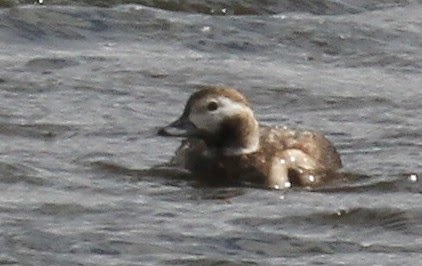
First stop was the comfy Lillian’s hide.   It wasn’t long before a sharp eye had located the female long tailed duck, continually in motion, on the water for seconds before it dived down
Long tailed duck- Neil P
again and again. Long tailed duck Others on the waters and islands, tufted duck, gadwall, goldeneye, teal, moorhen, coot, heron, greylag, lapwing, lesser black backed, herring and black headed gulls.
A solitary Snipe camouflaged, motionless sat huddled in the grass along the reed bed edge. Teal gleamed in the sunshine, in the grassy waters. No Water Rail today.
We then set out for the grit trays set up for the Bearded Tits, situated in the reed beds close to the causeway path. A Chiffchaff flitting around the pond dipping area was an unexpected bonus. Unfortunately the weather had turned blustery with intermittent heavy showers, this did not bode well and as expected the temperamental beardies failed to make an appearance.
A frantic shower dodging dash for the public hide ensued.  Here where mallard, gadwall, cormorants, pochard, coot, greylags, gt black backed gull, lapwings, tufted duck, gt crested grebes, grey heron and tufted duck. An excited shout alerted us to two otters frolicking at the back of the mere, apparently having made short work of an eel lunch. Sadly no Kingfisher streaking across the water or booming bittern sighted.
We made our way down the woodland path down to the lower hide noting yet more greylag and pheasant in the fields alongside.  At the hide a treat was in store.  Marsh Harriers hanging and swooping over the reeds, giving us great views of their underwing markings, both male and female. Impressive!!  Shelduck, shoveler and redshank stood out from the others seen before.
Marsh Harrier - Neil P


Time for a break and another café stop, we headed back along the path, another opportunity to tick a few more off, this time treecreeper, goldcrest, marsh tit and gt spotted woodpecker.
Mid afternoon, cake ate.
Spotted Redshank -Neil P

A quick visit to (Eric and Ernie hides) Allen and Eric Morecambe hides, before heading home. These hides look over the saltmarsh towards Jenny Brown’s point and Morecambe bay. Highlight of the saltmarsh pool was a splendid spotted redshank, giving us an opportunity to compare it to more common redshank nearby. Others added to our day list here included avocet, pintail, little egret, oystercatcher, curlew.
Another Jolly birding day out in beautiful Lancashire. 

Laura

Friday, 21 March 2014

Happy campers


Happy campers for happy wildlife in Merseyside Thousands of people will carry on camping for wildlife this summer by taking part in the RSPB' s Big Wild Sleepout.

From 16-22 June, the charity is encouraging people in Merseyside to spend a night under the stars to find out which creatures they share their homes with and raise money to help protect them.

UK wildlife will play host to all kinds of campers   adventurous campers will be building and sleeping in dens and shelters, some will stick to the traditional tent, others plan to sleep on their garden trampoline and some will just venture outdoors and sleep under the stars.

As well as getting their sleepouts sponsored to raise money and help save wildlife, everyone taking part can also do a range of activities, such as den building, torchlight safaris and bug hunting.

All of the money raised will go to help give nature a home. 
£20 could buy a nestbox for starlings.
£30 could pay for a GPS tag to monitor where a seabird flies to find food. 
£60 can help create homes for water voles.

To help people get the most out of their wild night out, the RSPB has produced a free fundraising pack full of everything you need to host a successful sleepout. It contains lots of fun ideas to make raising money really easy.

For those that don t have a garden, the RSPB is also organising some exciting Big Wild Sleepout events across the UK. With special night time activities like outdoor cooking, stories round the campfire and night time strolls, this is the ultimate summer sleepout experience for those looking for a wilder time. All events are
different and a full list will be available on the RSPB website www.rspb.org.uk/sleepout.

The Big Wild Sleepout is part of the RSPB s  Giving Nature a Home  campaign, which is aimed at inspiring everyone to do their bit for nature, wherever they live and however big their outside space.

Richard Bashford, Big Wild Sleepout organiser, says:  Most people who take part will probably help give nature a home throughout the year by providing food, water and shelter.

 The Big Wild Sleepout is your chance to take part in the RSPB's biggest fundraising event to help give nature a home. Join family or friends for a sponsored sleepout in your back garden or at your local
RSPB reserve.  Put up a tent, make a shelter or sleep under the stars and discover a whole world of wildlife you can help to save.

Some of our best loved garden favourites are among the creatures shown to be in serious trouble including starlings, hedgehogs, some butterflies and ladybirds. All are in danger of further declines unless
more is done to provide better habitats .
The Big Wild Sleepout is being supported by Blacks, the leading outdoor equipment specialist
Ken Reeve, CEO of Blacks, says:  Encouraging people   young and old   to get outdoors and experience nature first-hand is something we e really passionate about at Blacks. That' s why we re-supporting the Big
Wild Sleepout for the second year running. I can t wait to join in!

For more information, ideas on how to make the most of your Big Wild Sleepout, visit: www.rspb.org.uk/sleepout.

Wednesday, 19 March 2014

Moore surprises


Hi All,
Seeing that it was such a nice morning I had good intentions in getting to Moore before 08:00hrs but by the time i had written and sent off some emails and generally messed about it was 10:30hrs. So i didn't really have any hope in seeing much at all never mind seeing the Lesser Spotted Woodpecker.
I parked my car up and walked down lapwing lane popping in at the hide there but there was quite a ripple on the water and not much doing at all besides a few brave and hardy Coots showing.
So carried on down the lane and looked to my left to see four birders with scopes and camera equipment waiting for the Lesser Spotted Woodpecker to show.
I eventually made my way towards them after eating a crunchy nut bar held together with Canadian Maple Syrup. yum!
By this time most of the birders had walked back the way i had just come, so i persevered and just hung about waiting just in case the LSW showed up and decided to continued Fracking in its current nesting hole.
Less spotted- Neil P
While chatting to one birder from Stockport (which by the way had never seen a live LSW in his life), the bird showed and I had to point it out to him. He was so excited at seeing the bird for the first time, and kept on telling me so. I was so pleased for him that he had eventually seen his quarry.       (but For me it was as common as muck by now ... ha! ;-)))
At this point I was sitting down on the side of the path to gain a better (twigless) view of the bird drilling the tree and had taken my quota of photo's and was happy with what I had taken.
So offered my spot to another photographer who was very grateful of the better view of the bird. 
By this time the bird had been there a good 30 minutes happily drilling away and flicking the wood chips onto the ground below. It was well into the tree by the full length of it body with tail included.
From there, i made my way back to the lane and started to chat with one of the locals, when a young Vixen suddenly appeared in the roadway and just stopped in its tracks and looked at us. She had an old war wound floppy ear which was probably sustained in a previous fight.
Knowing that the foxes in the area tend to be quite tame, as the security personnel from a nearby warehouse feed them on scraps of meat from a local butcher and have hand fed the foxes for about eight years now.  
So I gave it a call and a whistle and it came trotting towards us and wandered around our feet sniffing for food.
Vixen  - Moore - Neil P
It was a sweet young female that you wouldn't really associate with it being a total killing machine and you couldn't help but admire and love its clean sleek lines and bushy tail.
I wondered if it would like some of my crunchy nut snack. So as soon as i got the packet out its one and a half ears pricked up at the noisy wrapper and became very interested.
I broke a piece off and threw it to her and she woofed it down licking her lips all the way.
At this point another photographer appeared and was over the moon, as he couldn't  believe his eyes at seeing the fox so close and so tame ... he immediately got onto the floor and was taking photo's of it at eye level. 
Each time I threw a piece of crunchy  nut bar, the Vixen would carry it away into the old Latchford canal undergrowth and ate it then returned for more ... I was rapidly running out of crunchy bar for it, as it must have been really hungry.
Then seeing that it was all gone, she trotted off quite nonchalantly to where the other group of people were who were still watching the LSW. She was obviously hoping that they perhaps would have some more interesting food for her.
When she suddenly appeared by them the lady jumped with sock then realised that it was a tame fox, so relaxed in amazement.
The Vixen came back to me as I put my empty hand out to her so that she could see that I didn't have any more food for her .. She licked my hand and made off to the nearby killing fields.
But what a thrill to be so close to nature and a magnificent friendly beast.


                                 Neil .............


Thursday, 13 March 2014

Are We Fit to Frack?


Fracking - Alamy
Issued on behalf of the Angling Trust, the National Trust, RSPB, the Salmon & Trout Association, The Wildlife Trusts and the Wildfowl & Wetlands Trust North West wildlife and water quality put at risk by fracking.

Poorly regulated fracking risks harming threatened species and polluting our waterways, according to a report produced by the UK' s leading wildlife and countryside groups. 
In the North West, fracking companies are planning to work on sites in the Fylde, Salford and East Lancashire. This has raised high profile concerns and protests in the Fylde and at Barton Moss near Eccles.

The report, Are We Fit to Frack?, was launched today by the Angling Trust, the National Trust, RSPB, the Salmon & Trout Association, The Wildlife Trusts and the Wildfowl & Wetlands Trust. It is supported by across party group of MPs including Zac Goldsmith, Alan Whitehead and Tessa Munt.

The report contains ten recommendations for making fracking safer as the Government continues its push to get companies to apply for licences to explore and drill for shale gas. 
The recommendations are based on a full technical evidence report which has been peer reviewed by the Centre for Ecology and Hydrology, one of the UK s leading ecological research institutes.

The countryside groups are calling for all protected wildlife areas, nature reserves and national parks to be frack-free zones, for full environmental assessments to be carried out for each drilling proposal, and for the shale gas industry to pay the costs of its regulation and any pollution clean-ups.

The report highlights a lack of regulation around shale gas exploitation which could cause serious impacts for a range of threatened species including pink footed geese, salmon and barbastelle bats.  It also raises serious concerns about the impact of drilling and water contamination on some of our most precious natural habitats such as chalk streams.  These crystal clear waterways are known to anglers and wildlife-lovers as England s coral reefs   85% of the world's chalk streams are found here.

Tim Melling, RSPB Senior Conservation Officer for Northern England, said:  The Prime Minister has been a great advocate for the shale gas industry. He has said we have the strongest environmental controls in this country and nothing will go ahead if there are environmental dangers. 

Our report puts a spotlight on these risks and reinforces the growing concern about the impact fracking could have on our countryside and wildlife.

In Lancashire we are extremely concerned about the impact that fracking could have on the 60,000 pink footed geese, which spend the winter around the Ribble and Alt Estuaries. As these geese have traditionally been shot in large numbers, they are rather skittish and very prone to disturbance. 
If the farmland in West Lancashire where they feed were to be punctuated with numerous fracking wells, each with its own access road, there is a risk they may abandon this landscape. Consequently, the extraction of shale gas could have a serious impact on this internationally important bird population. 

Anne Selby, Chief Executive of The Wildlife Trust for Lancashire, Manchester and North Merseyside, which covers the area where many of the proposed explorations are planned, said  As a Wildlife Trust, we are here to protect nature, but our purpose also includes sustainability and adapting to climate change.

We have concerns at a local level with regards to the impact of fracking, but we are also joining forces with the other 46 Wildlife Trusts to ensure the Government does not stray from renewable energy plans. We must not lose sight of aims to progress our energy sources into a more sustainable future

Shale gas is a non-renewable energy source. It may be billed as cleaner than coal, but it is carbon and will contribute to CO2 emission.  We have put a number of key questions to each of the fracking companies and await clear responses with regards to our concerns.

Simon Pryor, National Trust Natural Environment Director, said:  The debate on fracking needs to be evidence based. The evidence from this detailed research clearly reveals that the regulation of shale gas needs to be improved if it s to offer adequate protection for sensitive environments.

Whilst the Government is keen to see rapid roll out of fracking, there s a real danger that the regulatory system simply isn' t keeping pace. The Government should rule out fracking in the most sensitive areas and ensure that the regulations offer sufficient protection to our treasured natural and historic environment.

Martin Spray, Chief Executive of WWT, said:  A single frack can use more water than 1,000 people use in a year and if it goes wrong it could contaminate drinking water and ruin wetland habitats. That' a big burden on communities and it s a risk we want managed. Today's report clearly sets out the safeguards that need to be in place before this relatively new industry can operate in our countryside with a degree of safety.

Martin Salter, National Campaigns Coordinator for the Angling Trust said:  A poor fracking operation has the potential to pollute groundwater supplies and to cause damage to fragile ecosystems in our chalk streams and other rivers. That is why we need the strongest possible regulatory framework, funded from the profits of the industry rather than from taxpayers  pockets.

Janina Gray, Salmon & Trout Association Head of Science, said:   The water use of the UK shale gas industry could exacerbate pressure on rivers and wetlands, particularly on sensitive water bodies & those already suffering from over-abstraction, such as chalk streams, and this adds yet further pressure on declining fish populations - the Atlantic salmon being a prime example. This, coupled with the risk of water pollution   including groundwater contamination  could, if not correctly managed, be significant - possibly irreversible.  Action must be taken now to ensure all necessary environmental protection and regulatory frameworks are in place before extraction goes ahead.     

The report,  Are We Fit to Frack?  features ten recommendations for making the shale gas industry safe for wildlife. It is based upon the document  Hydraulic Fracturing for Shale Gas in the UK: Examining the Evidence for Potential Environmental Impacts , which has been written by the project partners and peer- reviewed by the Centre for Ecology and Hydrology (CEH). Both are available to download