|
| Mixed finches at feeding station L Bimson |
As you sit snugly by the fire this winter, spare a thought for our
feathered friends. Their survival skills are tested to the limit when winter
tightens its grip and food becomes hard to find. Freezing weather is a potential death sentence for many birds, but with
just a little water, food and shelter, gardens can become a vital haven for
birds and other wildlife
In days of yore the RSPB held a ‘Feed the Birds Day event’ every year on the third week of October. Nowadays we advocate people feed our birds all year round and the events have ceased. However we at RSPB Liverpool think it’s still a good time of year - as the nights draw in and our birds have less time to feed, to give out a timely reminder.
October is the month the clocks go back and the winter nights start drawing in - it's the time when birds and other wildlife need a little extra help as the first frost looms. So please fill your feeders, clean your bird tables, put out some water and give a helping hand to the wild birds around you. And the sooner you start feeding them, the more birds you'll see when you sit down to enjoy the RSPB's Big Garden Birdwatch in January! You may be surprised how the number changes according to the food you put out. And don't forget a place to sleep, start putting up nest boxes now to provide roost sites for smaller birds. They will then be used for breeding later in the year.
IN COLD WEATHER IT IS ESTIMATED THAT SMALL
BIRDS NEED TO EAT 30-40% OF THEIR BODY WEIGHT EACH DAY’
Feeding suggestions.
·
High calorie wild seed
mixtures, and straight seeds i.e. sunflower hearts
There are different mixes for feeders and for bird tables and ground
feeding. The better mixtures contain plenty of flaked maize, sunflower seeds,
and peanut granules.
 |
| Foraging Goldcrest L Bimson |
Small seeds, such as millet, attract mostly house sparrows, dunnocks,
finches, reed buntings and collared doves, while flaked maize is taken readily
by blackbirds. Tits and greenfinches favour peanuts and sunflower seeds.
Pinhead oatmeal is excellent for many birds.
Fat balls,suet cakes and pellets are excellent winter foods. You can make your own by mixing melted beef dripping and a mixture of ingredients such as seeds, nuts, dried fruit, oatmeal, cheese and cake crumbs. use about one-third fat to two thirds mixture. Allow to set in a feeding container, empty coconut shell or simply turn out onto the bird table once solid.
 |
| Male Blackcap eating fatcake L Bimson |
Mesh bags – a warning- Peanuts and fat
balls are regularly sold in nylon mesh bags. Never put out any food in mesh
bags. These may trap birds’ feet and even cause broken or torn off feet and
legs. Birds with a barbed tongue, eg woodpeckers, can become trapped by their
beaks.
·
Bread: has
very low nutritional content and is essentially filler, ideally it should only
be fed as part of a varied diet. Soaked bread is more easily ingested than
stale dry bread.
·
Windfall
and over ripe fresh fruit i.e. Apples, pears &
other soft fruit. Dried
fruits must be soaked before putting out, sultanas, raisins, currants.
 |
| Mistle thrush L Bimson |
·
Peanuts:
are rich in fats and are of major importance to tit and greenfinch flocks
during the winter and cold spring months. Salted peanuts should never be
used for bird food.
·
Rice and cereals: Cooked rice, brown or white (without salt added) is
beneficial and readily accepted by all species during severe winter
weather. Porridge oats must never be cooked, since this makes
them glutinous and can harden around a bird's beak. Uncooked porridge oats are
readily taken by a number of bird species. It is best offered dry, with a
supply of drinking water nearby.
·
Coconut: Give
fresh coconut only, in the shell. Rinse out any residues of the sweet coconut
water from the middle of the coconut before hanging it out to prevent the
build-up of black mildew. Desiccated coconut should never be used as it
may swell once inside a bird and cause death
Salt: Garden birds are practically unable to
metabolise salt, which in high quantity is toxic, affecting the nervous system.
Under normal circumstances in the wild, birds are unlikely to take harmful
amounts of salt. Never put out salted food onto the bird table, and
never add salt to bird baths to keep water ice-free in the winter.
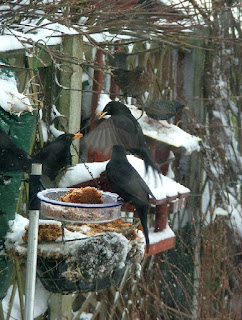 |
| Blackbirds fighting over cake L Bimson |
· Other kitchen scraps:
cake crumbs, a little mild grated hard cheese, leftover cooked potato - plain baked,
roast and pastry.
·
Wiggly worms? Mealworms, yes
I know they look like shiny maggots, but they are not so squishy, and handling
them is rather like grabbing a handful of animated rice! More to the point the
birds love them. Serve live or dried. It is very important that any mealworms fed to
birds are fresh. Any dead or discoloured ones should not be used as they can
cause problems such as salmonella poisoning.
 |
| Robins loves mealworms L Bimson |
'Wild birds are incredibly important in the lives of many people; the
RSPB's celebrates this special relationship and encourages everyone to feed
garden birds.
Good hygiene at bird feeding stations is
sensible.
When a large number of
birds are attracted into an area to feed, the danger of disease increases.
Prevention is always better than a cure,
and is the best thing you can do to help the birds.
Monitor the food you put out regularly. If the food
is taking days to clear either from consider reducing the amount of food
offered. Use a bird table and/or hanging feeders. A ground feeding tray is easier to keep clean and moved if all the
food hasn’t been ate before nightfall.* Rats are attracted to leftover food and
often carry diseases, which can affect birds or humans.
Keep bird tables and surrounding areas clean and
free from droppings or mouldy food, thus avoiding the risk of
infection by providing breeding grounds for parasites and bacteria. Clean and wash
the bird table and hanging feeders regularly using 5% disinfectant
solution, and try and move feeding stations to a new area frequently to prevent
droppings accumulating underneath. Water containers should be
rinsed out as droppings can accumulate in bird baths. Your personal hygiene is
also important. Please wear gloves when cleaning feeders and bird tables, and always
wash your hands when finished
Where is the best place to put a bird
table in my garden?
Bird tables should be placed where the birds are safe and will be able to
feed undisturbed. Avoid putting them near fences or dense hedges, where cats
can easily get to them. If there is a small bush nearby, birds can use
this as a look-out point to make sure it is safe.
Where cats are a problem, avoid putting food on
the ground, but use a bird table where cats cannot reach it.
|
||
Place feeders high off the ground but away from
surfaces from which a cat could jump.
|
||
Place spiny plants (such as holly) or an
uncomfortable surface around the base of the feeding station to prevent cats
sitting underneath it.
|
||
Make the table-stand slippery using a metal post,
or plastic bottles around non-metal posts.
|
||
Plant wildlife-friendly vegetation, such as
prickly berry bearing bushes like pyracantha, berberis and cotoneaster and
thick climbers in the garden to provide secure cover for birds. These should
be close enough to where birds feed to provide cover, but not so close that
cats can use it to stalk birds. This kind of planting may also provide
food and nesting sites.💚
|
||