Showing posts with label Rspb Leighton moss. Show all posts

Monday, 10 July 2017

RSPB Leighton Moss celebrates 30 years of iconic bird of prey


Marsh Harrier     David Mower

Thirty years ago this summer, RSPB Leighton Moss nature reserve in Silverdale made history.  For the first time in well over a hundred years, one of Britain’s rarest birds, the marsh harrier, returned to nest in Lancashire, choosing the reserve’s vast reed beds as its home. They have nested ever since and the site is encouraging visitors to come and witness these spectacular birds in action.
In the early 1970s just one pair of marsh harriers was known to nest in the whole of the UK but thanks to conservation efforts these spectacular birds slowly increased in number. In April 1987 a pair arrived at Leighton Moss and successfully raised three chicks at the RSPB’s flagship reserve. 
Marsh harriers are large and impressive birds of prey which usually spend the winter in Africa, returning here in the spring. It is thought that there are now around 400 pairs breeding in Britain every year. Unfortunately the recovery of marsh harriers has not been mirrored by the widely publicised decline of their close relative the hen harrier, which is perilously close to extinction as a breeding bird in England.
Since their return to Lancashire thirty years ago, marsh harriers have nested at Leighton Moss annually; raising in excess of 200 youngsters over three decades. Staff and volunteers have been keeping a close eye on the two nests at Leighton Moss this year and on 30 June they were thrilled to see the first chick taking its inaugural flight.
Over the coming weeks, the young birds will be stretching their wings and learning to hunt for themselves, so it’s the perfect time to visit Leighton Moss and Morecambe Bay nature reserve to see them. The parents are continuing to provide food for the hungry fledglings and visitors may see several harriers in the air at one time!
Jarrod Sneyd, Site Manager at RSPB Leighton Moss said “When these superb birds first nested on the reserve in 1987 we were thrilled. The success of marsh harriers at Leighton Moss over the last thirty years has been astounding and it goes to show just how valuable our precious wetlands and reed beds are to the wildlife that makes its home in these special places”.      
For the chance to see these iconic birds, pop along to the visitor centre at Leighton Moss between 9.30 am and 5 pm, where staff and volunteers will happily direct visitors to where the birds might be.
To find out more about the other amazing wildlife on the reserve and the range of events being held over the summer, visit rspb.org.uk/leightonmoss

Friday, 2 October 2015

Biffa Award brings reeds back to life at RSPB nature reserve

Otter at Leighton Moss - David Mower
The RSPB has been carrying out important nature conservation work at Silverdale Moss, a reedbed in North Lancashire, to make the site an even better place for wildlife.
Reedbed is a rare habitat in the UK, as much of it has been drained for farming and development.

14 years ago, the RSPB began creating Silverdale Moss, an extension to its well-known Leighton Moss nature reserve, to provide homes for special wetland wildlife. By transforming what was once a muddy field into a reedbed, the site is now popular with a range of birds and other animals. 

However, the RSPB’s dream to attract otters and bitterns – a rare type of heron – to the site has not yet been realised.  Both otters and bitterns live on a diet of fish. But the low water table a Silverdale Moss meant that the site wasn’t providing enough fish to entice them in.
Thanks to £48,000 of funding from Biffa Award, though, the RSPB has been able to take steps to rectify the situation.

Jarrod Sneyd, Site Manager at RSPB Leighton Moss and Morecambe Bay nature reserve explained “This generous funding has allowed us to make improvements on Silverdale Moss so we can better raise and control the water levels there. This will increase the fish available and hopefully encourage bitterns and otters to breed and thrive on the reserve. This work has enhanced the site for other special wildlife, helping to make the nature reserve bigger, better and more connected for nature.”

Gillian French, Biffa Award Programme Manager said “We are pleased to support such an exciting project to rebuild biodiversity in Leighton Moss. We will be following this project with great interest, in the hope of seeing otters and bitterns in this beautiful corner of Lancashire.”

Peter Bagnall


Wednesday, 26 March 2014

Hail, Hawfinches and Harriers

Watchers at the verandah 

Rob Pocklington National trust ranger met us at Sizergh Castle’s car park; here we hoped to see the cherry stone crunching Hawfinch.  Arriving at  8:00am, after a somewhat scary drive from the ‘pool,  managing to survive the onslaught of a massive hailstorm that fell from black skies as we cruised along the motorway, the world turned white and evidence of those who had travelled before skidding on the slippery surfaces!

Back at the car park expectation was high as Rob was busy telling us that the had seen nine birds the day before, 6 in the trees and  3 feeding on the ground;  when suddenly   2 birds flew over head, heading for the trees behind the cafe.  A tick but we hoped for better.

The playground/picnic area and surrounding Hornbeam trees(favoured by these finches) were busy with foragers, chaffinch, blue and great tits, wren, blackbirds, nuthatch, coal tit,  jay, robin, dunnock, goldfinch, bullfinch, collared doves, and song thrush.
Where was our quarry? A small party of four redwing flew over;  50 minutes later  a little unease was growing,  when  a single Hawfinch made an appearance and thankfully  landed on  the top of a cherry tree directly in front of the café verandah where we were all gathered. We had good views of the bird for a few minutes, as it flitted around in the tree, before it flew off.

9.15am and most of the watchers had retired to the café for bacon and sausage butties when the bird returned! this time it landed on the embankment and mooched about with the other foragers. Fantastic, the cafe had picture windows you didn’t even have to leave your seat!!
Hawfinch -South Cumbria Hawfinch Project

So there we have it objective achieved, before we left Rob told us about his work with the South Cumbria hawfinch project, hawfinches are in decline by 70% locally.  The group have been ringing and attaching radio trackers to the local hawfinches, in particular females as they hope to ascertain where the birds go to breed, with the plan of surveying the woodland areas they favour and subsequently re-create and maintain habitats for future generations.  However tracing the birds after has been difficult, in 2012 they were only able to track down a male who turned out to be 10 kilometres away! If you would like more information on the project then please contact Rob the ranger, robert.pocklington@nationaltrust.org.uk  Also if anybody sees colour ringed birds (red ring with 2 white digits on left leg) then please let him know.

With the clock ticking towards 10am we made our way to RSPB Leighton moss for a rendezvous with a few more local group members who hadn’t heard the cockerel call!
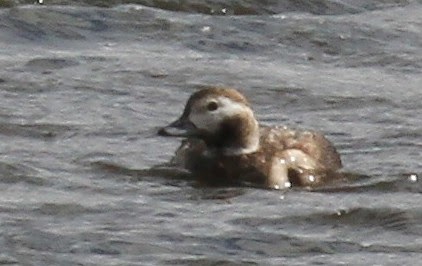
First stop was the comfy Lillian’s hide.   It wasn’t long before a sharp eye had located the female long tailed duck, continually in motion, on the water for seconds before it dived down
Long tailed duck- Neil P
again and again. Long tailed duck Others on the waters and islands, tufted duck, gadwall, goldeneye, teal, moorhen, coot, heron, greylag, lapwing, lesser black backed, herring and black headed gulls.
A solitary Snipe camouflaged, motionless sat huddled in the grass along the reed bed edge. Teal gleamed in the sunshine, in the grassy waters. No Water Rail today.
We then set out for the grit trays set up for the Bearded Tits, situated in the reed beds close to the causeway path. A Chiffchaff flitting around the pond dipping area was an unexpected bonus. Unfortunately the weather had turned blustery with intermittent heavy showers, this did not bode well and as expected the temperamental beardies failed to make an appearance.
A frantic shower dodging dash for the public hide ensued.  Here where mallard, gadwall, cormorants, pochard, coot, greylags, gt black backed gull, lapwings, tufted duck, gt crested grebes, grey heron and tufted duck. An excited shout alerted us to two otters frolicking at the back of the mere, apparently having made short work of an eel lunch. Sadly no Kingfisher streaking across the water or booming bittern sighted.
We made our way down the woodland path down to the lower hide noting yet more greylag and pheasant in the fields alongside.  At the hide a treat was in store.  Marsh Harriers hanging and swooping over the reeds, giving us great views of their underwing markings, both male and female. Impressive!!  Shelduck, shoveler and redshank stood out from the others seen before.
Marsh Harrier - Neil P


Time for a break and another café stop, we headed back along the path, another opportunity to tick a few more off, this time treecreeper, goldcrest, marsh tit and gt spotted woodpecker.
Mid afternoon, cake ate.
Spotted Redshank -Neil P

A quick visit to (Eric and Ernie hides) Allen and Eric Morecambe hides, before heading home. These hides look over the saltmarsh towards Jenny Brown’s point and Morecambe bay. Highlight of the saltmarsh pool was a splendid spotted redshank, giving us an opportunity to compare it to more common redshank nearby. Others added to our day list here included avocet, pintail, little egret, oystercatcher, curlew.
Another Jolly birding day out in beautiful Lancashire. 

Laura

Wednesday, 13 November 2013

NOT A MURMUR WAS SEEN AT LEIGHTON MOSS!!

Autumn Leighton Moss reflections - Laura Bimson

On a lovely morning nine of us set off to RSPB Leighton Moss; and what a beautiful day had dawned, a landscape covered in frost shining like diamonds, emblazoned foliage, autumnal hues from gold to russet.
Our merry band met in the centre’s coffee shop, cake and coffee to start our day (someone called Packham on autumnwatch had sold us on the idea!). 

Bearded tits- Laura Bimson
Sustained, we purposefully set out for the grit trays set up for the Bearded Tits, situated in the reed beds close to the causeway path. Here we came across a horde, a collection of scopes and bins with their assorted owners waiting in hope for a glimpse of the famed Bearded Tits.  Most of the watchers had been there in excess of 2 hours!!  We’d only waited for a few minutes when a wren arrived, heralded with great excitement as close on its tail it was followed by one, then two Bearded tits, a spectacular pair complete with multicoloured leg rings. We had lovely views of their stunning colour and moustaches as they collected their grit.

We then made our way to the public hide spotting Mallard, Gadwall, Mute swan, Grey heron and Tufted duck. Then great excitement Neil spotted a Kingfisher streaking low across the water to an inlet, out of site, awesome.
In flight Kingfisher - Neil Prendergast

We decided to move on and walked down the causeway, when coming to a clearing in the reed bed our Kingfisher was again espied!  Obligingly sitting on a branch over looking the waters.  It gave us wonderful
Kingfisher - Neil Prendergast
views of it stunning in plumage, as it turned the blue of its back left you breathless. It dived for a fish as we watched...  Magic. 

Marsh tit - Rhodie Blyth
Following the woodland path down to the lower hide we saw Blue and Great tit, Dunnock, Wren, Robin and best of all a Marsh tit – this cause a bit of an id debate, willow or marsh? Sean eventually confirmed it a Marsh tit later in the day.  At the hide what a treat was in store.  A male Marsh Harrier was sitting on the shore, untroubled, ignoring the Teal that passed perilously close. A commotion, suddenly the assorted ducks near the shore took flight, the Harrier stayed put? Wow, an otter, one of the reserve's family group, twisted and turned, frolicking or feeding who knows, alas only a brief sighting for the group. 
Marsh Harrier - Neil Prendergast
The Harrier then gave us an encore, lifting into the air, it set about hunting over the the trees, and to our surprise it was joined by another, a female, a beautiful aerial ballet ensued, Lucky us!!
Lillian's hide


Time for lunch, and what better place to eat your butties than the comfort of Lillian’s hide and a chance to search for the recently spotted long tailed duck.  It wasn’t long before an eagle eye had located the female bird.   It was only on the water for seconds before it dived down again and again.  Eventually, it decided it was preening time, so we got good views, especially through Ron’s telescope.
Snipe- Laura Bimson
Snipe abounded in the grass feeding with their wonderful probing beaks, Shoveler showed off the size of their beaks, huge!  Teal gleamed in the sunshine, a Water Rail squealed close by, but elusive as ever not seen.

Next, a quick visit to the Grizedale and Tim Jackson hides held no surprises, plenty of duck and snipe, but the hoped for Red deer or Bittern failed to make an appearance.

Visitors to the reserve appeared to swell as the afternoon wore on, tales of spectacular Starling murmerations brought in the curious.  We trooped out along the path overlooking the reed beds and pools, with the rest of the world we stood with baited breath, 6 starlings flew over - could this be the advance party?  A Peregrine Falcon came into view distant along the treeline perhaps in pursuit of our quarry? We waited, some ducks flew over. We waited some more, but not a Murmur!  Not a one! Our fellow watchers drifted off,  shame,  it was not to be, perhaps Neil was right- the Starlings had gone to Blackpool for the switch off of the Christmas lights!

But it couldn’t spoil what was a superbly happy day out birding with friends. 


Rodders and Lowra
Friendly Robin eating mealies from Laura's hand  - Rhodie Blythe