Sunday, 16 February 2020

Mini Merseyside Big Garden Birdwatch count 2020


This was our fifth mini Big Garden birdwatch, having started our recordings in 2016. This year 35 sites were observed in our count, mainly gardens with a few parks. A total of 966 individuals, and 40 different species were reported seen.
As our recording sites differ from year to year it can be difficult to ascertain changes in bird population but some things remain fairly constant and that is once again robin, blackbird and bluetit were the species most seen in our gardens; And those with the highest number of individuals seen at any one time were the flocks of goldfinches, starlings and in the last 3 yrs house sparrows. No Parakeets were recorded this year? some would say a good thing!  And no reports of rare birds dropping in, unlike last year’s lovely brambling.
It’s nice to see blackcaps are still being seen in our winter gardens, having been counted every year since 2016, with goldcrests 4 of 5yrs. Sadly our song and mistle thrushes are scarce, 2016 being the highest count for song thrush at 8 in 4 sites now down to 2 in 1 or 2 sites.  Red listed starlings appear to be on a downward trend, with 139 in 2016 and 91 this year.  Happily fellow red listed house sparrows appear to be on the up, year on year increases from 64 in 2016 to 110 this year.

RED, AMBER GREEN

Last year’s results:


For those of you who have enjoyed taking part in the Big Garden Birdwatch and would like to record more, please consider joining the BTO Garden BirdWatch , this will involve you recording your birds every week and uploading them to the BTO website. The count includes other nature sightings such as insects and  mammals and also records the type of food you put out, more recently they have included your sightings of diseased and dead specimens.


Many thanks to all those who took part in our little survey, I hope you find it of interest. Please free to add your comments and observations, on our blog.

SPECIES
TOT No’s of birds seen
RANK
By No’s seen
RANK
By Gdns seen in
No’s of Gdns seen in
BLACKBIRD
62
6
2nd
28
WREN
9
16
14
8
BLUE TIT
83
4
3rd
27
GREAT TIT
56
7
4
25
COAL TIT
14
13
12
10
LNG TD TIT
43
10
11
12
ROBIN
49
9j
1st
29
BLACKCAP
2
20j
19j
2
STARLING     R
91
3rd
13j
9
DUNNOCK     A
28
12j
7
19
HOUSE SPARROW     R
110
2nd
10
13
FERAL PIGEON
65
5
13j
9
WOOD PIGEON
51
8
6
22
COLLD DOVE
37
11
9
14
GOLDFINCH
113
1st
8
17
CHAFFINCH
28
12j
11
12
GREENFINCH
12
14j
15
6
JAY
5
17j
18j
3
JACKDAW
11
15
16
5
MAGPIE
49
9j
5
23
CROW
5
17j
17j
4
GOLDCREST
3
19j
18j
3
NUTHATCH
12
14j
13j
9
SONG THRUSH        R
2
20j
20j
1
GREY WAGTAIL     R
1
21j
20j
1
SPARROWHAWK
2
20j
19j
2
GREAT SPOT WOODPECKR
4
18
17j
4
BULLFINCH
2
20j
20j
1
PIED WAGTAIL
3
19j
19j
2
REED BUNTING      A
3
19j
20j
1
MOORHEN
1
21j
20j
1
BLACK HEAD GULL             A
1
21j
20j
1
HERRING GULL             R
2
20j
20j
1
PHEASANT
1
21j
20j
1
REDWING
5
17j
20j
1
COMMON GULL
5
17j
20j
1
BUZZARD
3
19j
18j
3
GREY HERON
1
21j
20j
1
LSSR BLK BK GULL
1
21j
20j
1
MISTLE THRUSH
2
20j
20j
1


Tuesday, 11 February 2020

Parkgate Field Trip, 9th February 2020: A High Tide to Remember

As group leader you always have to turn up at an organised walk even if you think no one else would want to. So today, although lots of people heeded the warning about Storm Ciara, six of us braved the day. Meeting at the Old Baths car park at Parkgate, we stayed in our cars and birdwatched through the windows. Four goosander, a male and three females, flew in and landed on the Old Baths pool to join the curlew, redshanks, little egret, teal and mallard already there. Behind the cars in the grass a flock of redwings and blackbirds were working their way through the saturated grass looking for worms. As the wind was getting stronger, large flocks of lapwings and pink-footed geese were swirling around trying to find some safe areas to land. Ducks of various species were moving off the outer marsh as the tidal surge was pushing in. Marsh harriers could be seen trying to hunt but the wind was playing havoc with their plans.

We left the car park and decided that the Boathouse would be the best place to enjoy the spectacle that was unfurling before us, with tea and coffee. The staff are always very accommodating and the views very special. The storm hit and you couldn't see out of the windows but as each squall went through it would brighten up and we had two male hen harriers 30 feet away from the windows. Then water rails, reed buntings, skylarks, rock and meadow pipits could be seen searching for seeds and food on the floating detritus. With all this food, a few stoats started to appear. They were in a cross between winter and summer fur, so showing lots of white in their coats. We witnessed one stoat grab and kill a bird and then move on to something else, like the gulls, which were grabbing voles, shrews and other parcels of food. The storm surge had added a metre and a half on 9.7m tide, turning it in to an exceptional  high tide. 

We walked outside and witnessed three water rails running over the vegetation to safety by the pub while a number of people along Parkgate were trying to collect lots of the voles, shrews and mice to give them a chance of survival. Yes, the weather at times was atrocious but the breaks offered a once in a lifetime spectacular never to be forgotten. 


A lovely cup of coffee in the warmth of the Boathouse, photo by Rhodie Blythe

The incoming tide, photo by Rhodie Blythe

Spot the stoat, photo by Rhodie Blythe

Chris Tynan

Indoor Meeting, Monday 20th January 2020


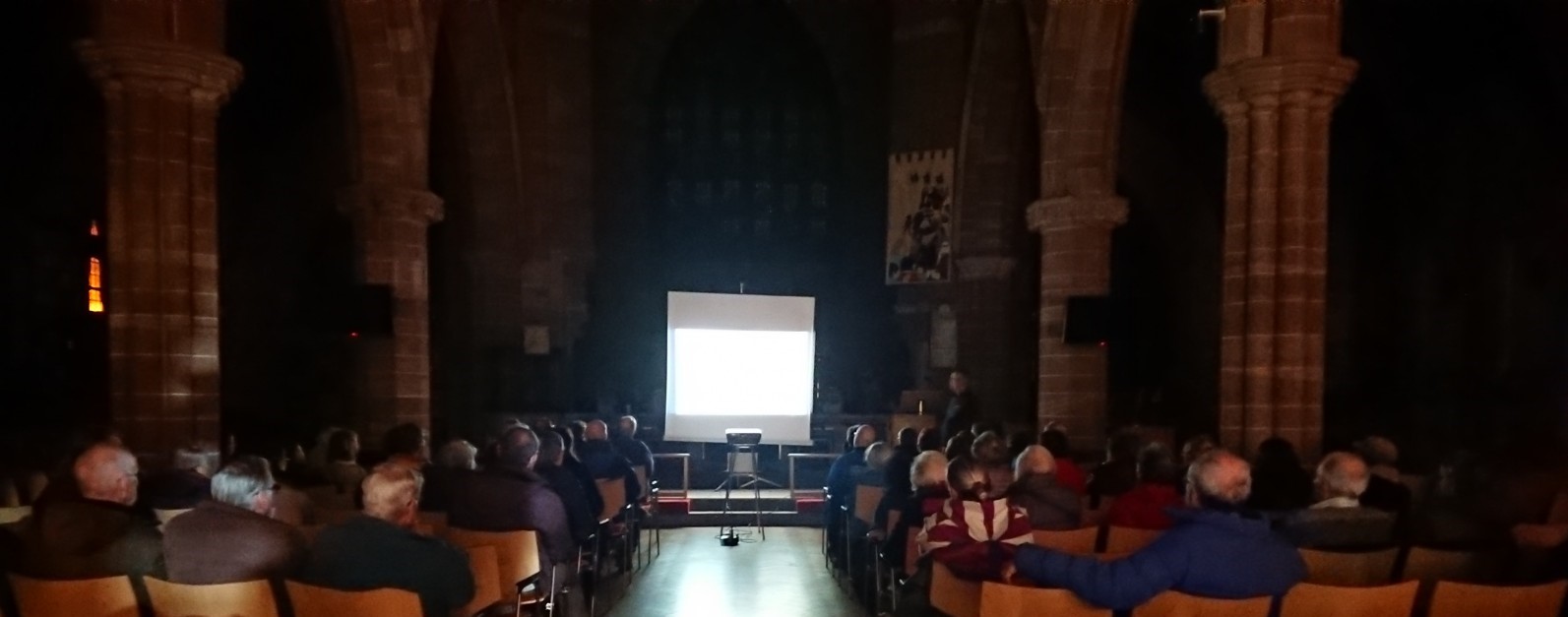
Bird photographer Richard Steel entertained a large crowd at Monday night’s meeting with a presentation, Beyond 66.5 Degrees North, covering his recent journey to North East Norway and the birds he photographed there – and the *rather* expensive restaurant prices!

The crowded hall, photo by Debra Williams
 We were taken on a journey from Manchester airport to close to the Arctic Circle, at a time of year when the sun – and thus the photographer – never sleeps. Photo after photo, clear as day, and yet taken at 11pm or 3am (they’re a hardy breed, professional bird photographers).
The gorgeous red-spotted bluethroat was the subject of quite a few photographs – a personal favourite/obsession, as Richard explained. Pine grosbeak, dotterel, red phalarope, lekking ruff, and the daintily beautiful red-throated diver – we see some of these species in the UK, but not usually in their amazing breeding plumages, so Richard’s photos were an absolute delight.
Lekking ruff, image taken from Richard Steel's presentation, photo by Debra Williams
 My personal favourite was the Siberian tit – what a lovely little bird! But I’m sure other attendees had other favourites from the many great photographs we saw. For those of you who were unable to attend – or who did but want to learn more about the wildlife he photographs – Richard’s blog contains more details and photographs of his trips to Norway, and other places such as Extremadura, and is well worth a look: http://wildlifephotographic.blogspot.com/search/label/Arctic%20Norway.

Also on the evening, we had a visit from Alasdair McKee, RSPB Local Groups Officer, who presented a number of our volunteers with long-standing achievement badges:

Phillip Antrobus - 15 years
Rhodie Blythe - 5 years
Jen Jones - 5 years
Anne Pope - 10 years
Ann Thomson - 10 years

Phillip Antrobus receiving his award from Alasdair McKee, photo by Debra Williams

Jen Jones receiving her award from Alasdair McKee, photo by Debra Williams


Anne Pope receiving her award from Alasdair McKee, photo by Debra Williams

Ann Thomson receiving her award from Alasdair McKee, photo by Debra Williams

Debra Williams

Tuesday, 21 January 2020

RSPB Liverpool Pre-Big Garden Birdwatch Event at Sefton Park Palm House, 19th January 2020

In eager anticipation of the RSPB’s 42nd Big Garden Birdwatch on 25th to 27th January 2020, RSPB Liverpool held a pre-event at Sefton Park Palm House on Sunday, 19th January. Despite the heavy fog, 562 people found their way to the Palm House, a number of whom took out new national memberships, and bought pin badges (beating John’s 2019 total) and posters, and also made a number of donations on the door. All this support helps us continue our work focusing on the conservation of and education about the UK’s birds.
Sean and Phil had their scopes up outside the Palm House, and the bird feeders had been well stocked, so there was a constant stream of small visitors – including coal tit, long-tailed tit and nuthatch, with a sparrowhawk having a quick look in at one stage. Thrillingly, on a walk around the park, one of the kingfishers was also seen, in the Fairy Glen. (The photo is from the previous day’s bird walk led by our group leader, Chris Tynan, and was taken by Friends of Sefton Park volunteer Tana.)

Photo by Tana, Friends of Sefton Park Volunteer

Inside the Palm House, activities included face painting, and studding apples with sunflower seeds and threading them with twine to make eco-friendly bird feeders which children (and adults) could take home. As can be imagined, there were queues to participate in these activities, and thanks are due to Chris for sourcing the apples and to the volunteers who cored what must have felt like hundreds of them!

Photo by Laura Bimson


Photo by Debra Williams

Other volunteers were on hand to help visitors choose posters and pin badges to buy, and to explain the large range of leaflets on display, as well as the main purpose of the event: to promote the RSPB’s Big Garden Birdwatch, now in the 42nd year of an extremely important citizen science project.

Photo by Laura Bimson

Almost half a million people across the UK participated in 2019, including over 6,600 on Merseyside, counting over 7.5 million birds in total. Once the data has been submitted, he RSPB team collates and cleans it and then sorts it in different ways, e.g., looking for abundance (average number of species seen in each garden) and distribution (percentage of gardens in which the birds were seen). Comparing this data over the years gives a very good idea of how different species are doing. For example, Merseyside data for 2019 showed a decrease in sightings of both wrens and long-tailed tits, which had been counted in particularly large numbers in 2018. Is the 2019 decline the beginning of a trend or is it just low in comparison to 2018’s large numbers? Hopefully, this year’s data will shed some light on this.
The results help the RSPB spot any troubling declines in our garden birds and alert the public to them and to the ways in which we can all contribute to reversing them, e.g., by putting out different bird feed or making our gardens more wildlife-friendly.
Children attending the event were also told about the RSPB’s Big Schools Birdwatch. Around 400 Merseyside schools took part last year, and we hope that this number will increase this year. Interestingly, although nationally the blackbird was in top spot for this part of the project, the most numerous species seen by Merseyside schoolchildren was black-headed gulls – an indication of the region’s coastal location. (There was a big party of gulls loafing on the field opposite the Palm House, showing that these birds aren’t just found on the water!)
All in all, a great day was had by all – visitors and volunteers – and everyone is now geared up to participating in the Big Garden Birdwatch. Will the house sparrow stay in top spot both in the UK overall and on Merseyside for yet another year, or will it be knocked off its perch (sorry!) by last year’s second-place bird, the starling?
(More information about 2019’s results can be found at: https://www.rspb.org.uk/get-involved/activities/birdwatch/results/.) 

Debra Williams