
 |
| Busy Kids in the Palm House |
Once more unto the breach, dear friends, once more;
Well, maybe a tad over-dramatic, but sometimes the weather makes
you feel like that. Saturday dawned, - the
day of our 'Big Garden Birdwatch' at Sefton
Park’s Palm House, and yes it was raining again; - we shouldn’t be surprised, but
we’re English and it’s a national past time talking about the weather!
This year we broke from tradition and actually held the event on the
national birdwatch weekend instead of the week before.
Our aim, to tell as many people as possible about the RSPB’s 'Big Garden
Birdwatch' which now covered three days Saturday 28th to Monday 30th January, giving more people a chance to record their feathered friends.
Warm and dry in the Palm House, grey and damp outside! Despite the precipitation we had a steady
stream of visitors at our stalls. All kinds of questions were fired at us:- how to attract birds, squirrel proof-bird
feeders, best food, gardening and best plants, what’s that bird, how do you
tell the difference, how do I join, where can I buy, problem cats and magpies,
where’s the
kingfishers, where’s the parakeets (popular residents of the park).
 |
| Female kingfisher |
 |
| Mr Ring necked parakeet |
 |
| National Wildflower Centre |
Whilst we were there we took the opportunity to promote a petition to help re-launch the National Wildflower Centre in Court Hey Park. Recently closed, the staff and volunteers are desperately trying to rally
support for its revival. http://nwc.org.uk/
An important local community resource which must not be allowed to
disappear.
Our friends on the national RSPB table Derek and Joan, were kept busy and
we were very pleased to hear five national memberships had been taken up.
 |
| Derek in charge |
Derek
and Joan volunteer at the RSPB’s Burton Mere Wetlands reserve on the Wirral http://www.rspb.org.uk/reserves-and-events/find-a-reserve/reserves-a-z/reserves-by-name/d/dee-burtonmerewetlands/index.aspx
and their presence at the Palm House meant they had
the opportunity to highlight the reserves attractions to hopefully future
visitors.
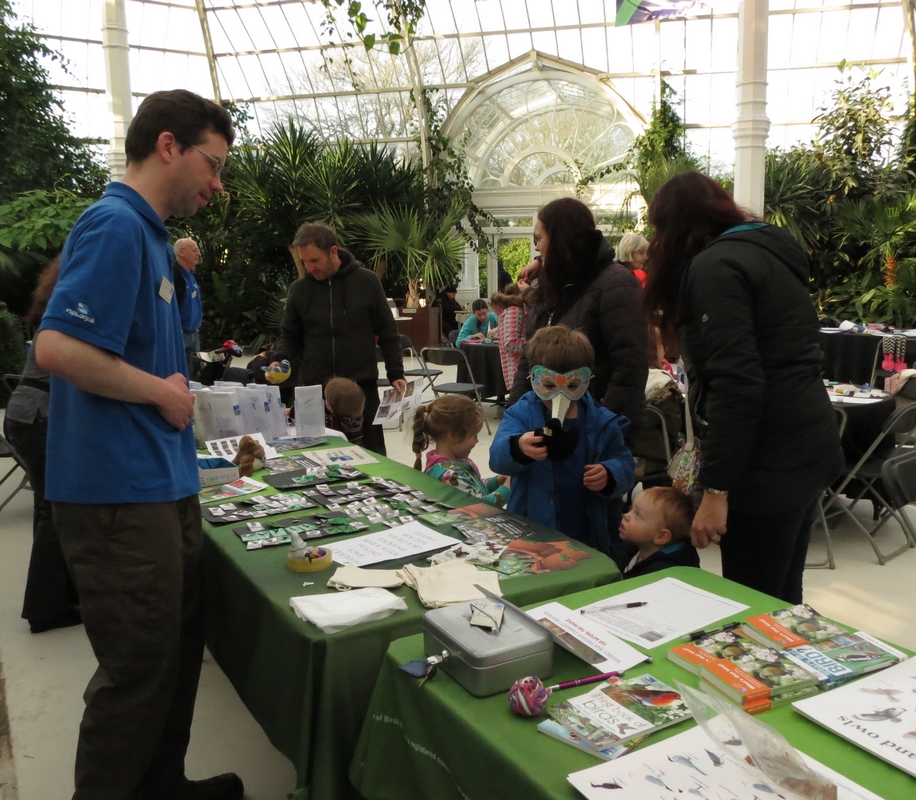
Our Wildlife Explorers (Wex) group, aimed at young people- (http://www.rspb.org.uk/groups/liverpoolwex), also had lots of visitors and
children were observed happily ‘colouring in’ and making masks with the Palm
house volunteers.
 |
| Proud Joe and uncle Terry |
 |
| John and youngsters |
Whilst most of the team were based inside advising and selling at our tables,- Phil placed our telescopes in the entrance porch focused on the garden’s bird tables (pre -stocked with seed, fat and scraps) and on the surrounding trees. Parakeets and flocks of redwings were seen in the trees whilst on the tables all the usual foragers were seen including numerous nuthatches caching sunflower hearts; great, coal and blue tits, magpies, robins, wood pigeons, jays, crows and squirrels and yes one large rat!
 |
| Nuthatch |
A little further a field Chris took an inquisitive young man and his dad onto the adjacent playing fields to look for two Mediterranean gulls. Successful, all part of the service!
 |
| Med gull in front |
 |
| Chris and Med gull seekers |
Another volunteer’s insight:
The one moment that really stands out
for me is when a little boy aged around three or four was totally overjoyed by
the 'singing' blackbird toy. A lot of children were interested in the bird toys, but
this little boy's reaction was outstanding: when we made it sing, his eyes were
like saucers and he couldn't stop laughing and clapping his hands together. His
mum was crouched down next to him and she was amazed at his reaction, too, so
it didn't seem to be something he did for just any old thing. In fact, he was so
excited and thrilled by the blackbird's song that he accidentally pushed
against his mum as she was crouching down, and she over-balanced! He kept
coming back over to the table and listening to all the birds, but the blackbird
was by far his favourite. http://shopping.rspb.org.uk/sale-offers-promotions/gifts-home-offers/rspb-singing-blackbird-soft-toy.html
 |
| Shore larks |
Debra
**********************
Once again we have undertaken a mini Merseyside birdwatch count:- 26
households across Merseyside, Rainford and Newton sent in their
counts, which you can see in the table below.
This year I’m pleased to say most people were happy with their counts with
only a few describing their results and experiences as - disappointing with favourite
birds arriving late. The response from the RSPB to ‘bad’ years was to extend
this year's count to three days, perhaps it did the trick?
I’m sure you’ll draw your own conclusions from the table below
SPECIES
|
NO’ OF
GDNS
SEEN IN
|
TOTAL
NOS OF
BIRDS
SEEN |
RANK
By no’s seen
|
RANK
By gardens found in |
Red
Amber
Green
|
BLACKBIRD
|
21
|
58
|
4th
|
2nd
|
|
WREN
|
6
|
6
|
16
|
10
|
|
BLUE
TIT
|
23
|
49
|
6
|
1st
|
|
GREAT
TIT
|
17
|
26
|
8
|
4th j
|
|
COAL
TIT
|
10
|
13
|
14
|
8
|
|
LONG
TAILED TIT
|
6
|
11
|
15
|
10
|
|
ROBIN
|
19
|
25
|
9
|
3rd
|
|
BLACKCAP
|
3
|
3
|
17
|
12
|
|
STARLING
|
9
|
59
|
3rd
|
9
|
R
|
DUNNOCK
|
12
|
19
|
10
|
7
|
A
|
HOUSE
SPARROW
|
13
|
52
|
5th
|
6
|
R
|
FERAL
PIGEON
|
13
|
63
|
2nd
|
6
|
|
WOOD PIGEON
|
17
|
34
|
7
|
4th j
|
|
COLLARED
DOVE
|
9
|
15
|
13
|
9
|
|
GOLDFINCH
|
13
|
102
|
1st
|
6
|
|
CHAFFINCH
|
10
|
18
|
11
|
8
|
|
GREENFINCH
|
9
|
16
|
12
|
9
|
|
JAY
|
1
|
1
|
1+
|
14
|
|
JACKDAW
|
4
|
11
|
15
|
11
|
|
MAGPIE
|
14
|
25
|
9
|
5th
|
|
CROW
|
3
|
3
|
17
|
12
|
|
LESSER
BLACK BACK GULL
|
1
|
1
|
19
|
14
|
A
|
NUTHATCH
|
2
|
3
|
17
|
13
|
|
GT
SPOTTED WOODPECKER
|
3
|
3
|
17
|
12
|
|
SONG
THRUSH
|
1
|
1
|
19
|
14
|
R
|
PIED
WAGTAIL
|
1
|
2
|
18
|
14
|
|
GREY
WAGTAIL
|
2
|
3
|
17
|
13
|
R
|
SPARROWHAWK
|
1
|
1
|
19
|
14
|
|
BLACK
HEADED GULL
|
1
|
1
|
19
|
14
|
A
|
REED
BUNTING
|
1
|
1
|
19
|
14
|
A
|
PHEASANT
|
1
|
1
|
19
|
14
|
|
BUZZARD
|
1
|
1
|
19
|
14
|
GREY SQUIRRELS 4 households, 7 individuals HEDGEHOGS 2 households, 2 individuals
RED, AMBER GREEN https://www.rspb.org.uk/birds-and-wildlife/bird-and-wildlife-guides/bird-guide/redliststory.aspx
I was not surprised to see goldfinches at the top as these birds have
been in the ascendancy in recent years, and numbers were still trending upwards despite
only visiting half of our households.
Once again feral pigeons got in on the act, much to the annoyance of some
households - the hated 'rats with wings!'
Blue tits topped the table for birds most likely to be seen with 23 of
26 households reporting. Black birds were close behind
I was pleased to see an increase in
starling numbers: a 78% increase with one extra household reporting them.
Our sparrow numbers were the same, although 13 households now reported
them, up from eight in 2015.
Nor was I surprised to see wood-pigeon in the top 10 either,
increasing in numbers and in households seen. These birds are moving in to suburbia
from their more traditional farmland habitat.
There was a very poor return for thrushes, only one was seen, a sign of the times, and no Scandinavian
visitors - fieldfare & redwing. Perhaps the weather was too mild.
For those of you who have enjoyed taking part in the Big Garden Birdwatch and would like to record more, please consider joining the BTO Garden BirdWatch , this will involve you recording your birds every week and uploading
them to the BTO website. The count includes other nature sightings such as insects
& mammals and also records the type of food you put out, more recently they
have included your sightings of diseased & dead specimens.
Many thanks to all those who took part in my little survey, I hope you
find it of interest. Please free to add your comments and observations, on
our blog.
Merseyside 2016
|
||
1
|
Merseyside
|
House sparrow
|
2
|
Merseyside
|
Blackbird
|
3
|
Merseyside
|
Starling
|
4
|
Merseyside
|
Woodpigeon
|
5
|
Merseyside
|
Blue tit
|
6
|
Merseyside
|
Goldfinch
|
7
|
Merseyside
|
Magpie
|
8
|
Merseyside
|
Robin
|
9
|
Merseyside
|
Great tit
|
10
|
Merseyside
|
Feral pigeon
|


