Showing posts with label palm house. Show all posts

Saturday, 19 January 2019

Celebrating 40 years of counting garden birds in Merseyside


RSPB Big Garden Birdwatch is 40! (26-28 January 2019)

·         The RSPB is celebrating 40 years of its’ famous Big Garden Birdwatch.
·        Over 8 million hours have been spent watching garden birds since the Birdwatch began in 1979 with more than 130 million birds counted.
·    To mark the event, the RSPB is asking participants in Merseyside ‘How will you #BigGardenBirdWatch?’ and to share their stories of how they take part.
·         Events are taking place in Merseyside to help celebrate.

The RSPB is eagerly anticipating who will be top of the pecking order for a very special anniversary of its’ world famous Big Garden Birdwatch in January.
Just one hour every year, for the last 40 years, has made the RSPB’s Big Garden Birdwatch the largest garden wildlife citizen science project. During that time, hundreds of thousands of people, including those across Merseyside, have volunteered their time providing the RSPB with over 8 million hours of monitoring garden birds.
To mark the event, the RSPB is encouraging participants in the county to share their Big Garden Birdwatch stories on social media. ‘How will you #BigGardenBirdWatch?’ will showcase some of the best examples of how people take part, from building their own birdwatching den, baking birdseed cakes and dressing up as Batman to see Robin.

This year’s Big Garden Birdwatch takes place on 26, 27 and 28 January 2019. The public is asked to spend just one hour watching and recording the birds in their garden or local green space, then send their results to the RSPB. Close to half-a-million people join in the Birdwatch every year, with over 6,000 across Merseyside taking part in 2018.
To help prepare for Big Garden Birdwatch 2019, there are events on offer across Merseyside this January – from discovering how to attract more wildlife into your garden to gaining tips on how to identify the creatures that live on your doorstep:

Get Ready for the Big Garden Birdwatch’ will be held at RSPB Burton Mere Wetlands nature reserve near Neston on Sunday 20 January. Drop-in from 1-3pm to make bird feeders, and the knowledgeable team will also be on hand to assist with garden bird identification to help you prepare for the birdwatch. Cost £2 per feeder, normal entry fees apply to non-members visiting the reserve (RSPB members free), no booking needed.

A ‘Big Garden Birdwatch quiz trail’ will also be taking place at Burton Mere Wetlands throughout the month. Families are encouraged to take part in this self-led activity to discover more about garden birds and how to take part in the Birdwatch. Cost £1 per quiz sheet, normal entry fees apply to non-members visiting the reserve (RSPB members free), no booking needed. More details for both can be found at rspb.org.uk/burtonmerewetlands

Meet the RSPB Liverpool Local Group in the Palm House at Sefton Park, Liverpool on Sunday 20 January. Volunteers will be on hand from 12-4pm with information about taking part in the Big Garden Birdwatch, assisting with bird identification and advising on how to attract garden wildlife.
Over the last 40 years, 130 million birds have been counted giving the RSPB an astonishing amount of insight into how our wildlife is faring.

For four decades, Big Garden Birdwatch has highlighted the winners and losers in the garden bird world. It was first to alert the RSPB to the decline in song thrush numbers. The song thrush was a firm fixture in the top 10 in 1979. By 2009, its numbers were less than half those recorded in 1979, plummeting to 20th in the rankings.

Mike Clarke, RSPB Chief Executive, said:Everyone has a role to play in saving nature and protecting our wildlife. Big Garden Birdwatch participants have made a significant contribution to monitoring garden bird numbers over the past four decades. Those taking part work together as part of a community with thousands of other Big Garden Birdwatchers, to help the RSPB’s work to protect birds, other wildlife and the places they live.
“Reaching 40 years is a huge achievement and shows just how passionate people across the UK are about their wildlife.  The survey started as a winter activity for our youth members. It’s now the largest garden wildlife survey in the world and appeals to both children and adults because it’s an enjoyable, easy, inclusive activity that anyone can do, and a great opportunity to connect with nature.”
The survey has also shown the increases in collared dove and woodpigeon numbers and the alarming declines of the house sparrow and starling. While the overall decline in house sparrow numbers, reported by participants, since the Big Garden Birdwatch began is 57% (1979 – 2018), in the most recent decade (2009-2018) numbers appear to have increased by 17%.
As well as counting birds, the RSPB is once again asking participants to log some of the other wildlife they have seen throughout the year. This year, people are being asked to look out for badgers, foxes, grey squirrels, red squirrels, muntjac deer, roe deer, frogs and toads.
To take part in the Big Garden Birdwatch 2019, watch the birds in your garden or local park for one hour at some point over the three days. Only count the birds that land, not those flying over. Send the RSPB the highest number of each bird species you see at any one time – not the total you see in the hour.
For a FREE 40th anniversary Big Garden Birdwatch pack, which includes a bird identification chart, plus RSPB shop voucher and advice to help attract wildlife to your garden, text BIRD to 70030 or visit rspb.org.uk/birdwatch  
The parallel event, RSPB Big Schools’ Birdwatch takes place during the first half of spring term (2 January – 22 February 2019). More than 60,000 schoolchildren, including over 670 in Merseyside, spent an hour in nature counting birds in 2018. Further information can be found at rspb.org.uk/schoolswatch


 Big Garden Birdwatch results: Comparison of what was in the top 10 in 1979 vs 2018.


           Long term trends – % change trends back to 1979 only available for 10 species and    from 1999 to 2018 for 15 species.


3.    While the overall decline in house sparrow numbers, reported by participants, since the BGBW began is 57% (1979 – 2018), in the most recent decade (2009-2018) numbers appear to have increased by 17%. This is reflected in more standardised national monitoring programmes (eg: BTO/JNCC/RSPB Breeding Bird Survey).


   The top 10 birds in 2018 RSPB Big Garden Birdwatch for Merseyside: 


5.     In 2014, as a new part of Big Garden Birdwatch, the RSPB asked participants to tell us about some of the other animals in their garden. This year we’re asking people to look for: badger, fox, grey squirrel, red squirrel, muntjac deer, roe deer, frog and toad. We’d like to know if any have visited their garden or local park in the last year and, if so, how often.

6.     

Thursday, 2 February 2017

BIG GARDEN BIRDWATCH - 2017 EVENT


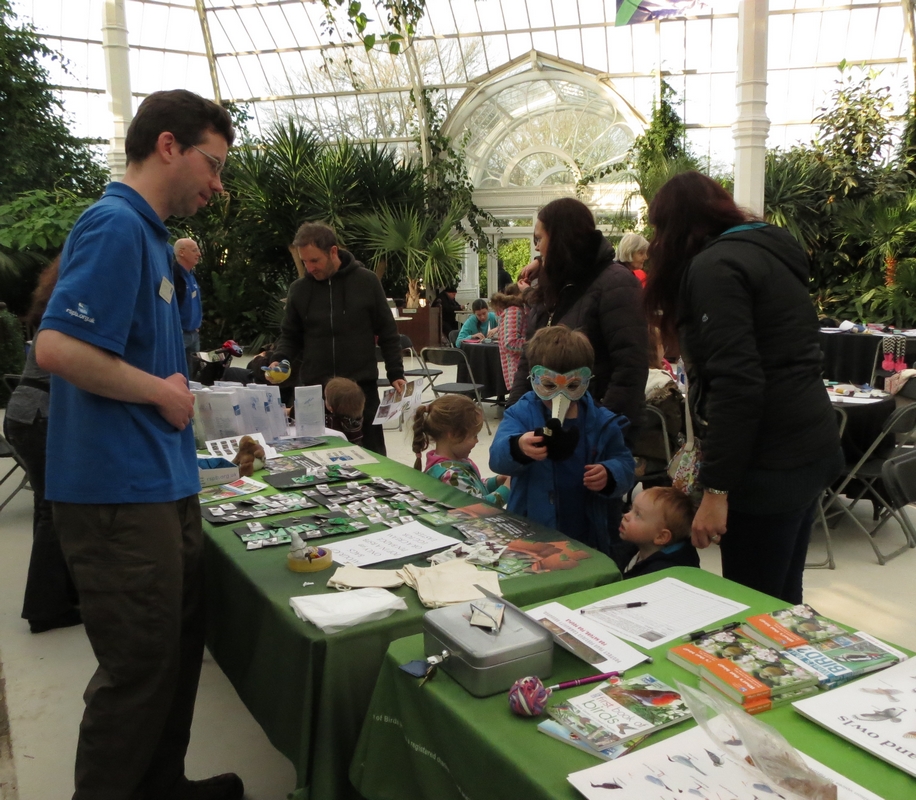
Busy Kids in the Palm House
Once more unto the breach, dear friends, once more;
Well, maybe a tad over-dramatic, but sometimes the weather makes you feel like that. Saturday dawned, - the day of our 'Big Garden Birdwatch' at Sefton Park’s Palm House, and yes it was raining again; - we shouldn’t be surprised, but we’re English and it’s a national past time talking about the weather!
This year we broke from tradition and actually held the event on the national birdwatch weekend instead of the week before.
Our aim, to tell as many people as possible about the RSPB’s 'Big Garden Birdwatch' which now covered three days Saturday 28th to Monday 30th January, giving more people a chance to record their feathered friends.
Warm and dry in the Palm House, grey and damp outside! Despite the precipitation we had a steady stream of visitors at our stalls. All kinds of questions were fired at us:- how to attract birds, squirrel proof-bird feeders, best food, gardening and best plants, what’s that bird, how do you tell the difference, how do I join, where can I buy,  problem cats and magpies, 
where’s the kingfishers, where’s the parakeets (popular residents of the park).

Female kingfisher
Mr Ring necked parakeet

National Wildflower Centre

Whilst we were there we took the opportunity to promote a petition to help re-launch the National Wildflower Centre in Court Hey Park. Recently closed, the staff and volunteers are desperately trying to rally support for its revival. http://nwc.org.uk/
An important local community resource which must not be allowed to disappear.

Our friends on the national RSPB table Derek and Joan, were kept busy and we were very pleased to hear five national memberships had been taken up.

Derek in charge
Derek and Joan volunteer at the RSPB’s Burton Mere Wetlands reserve on the Wirral http://www.rspb.org.uk/reserves-and-events/find-a-reserve/reserves-a-z/reserves-by-name/d/dee-burtonmerewetlands/index.aspx
and their presence at the Palm House meant they had the opportunity to highlight the reserves attractions to hopefully future visitors.

Our Wildlife Explorers (Wex) group, aimed at young people- (http://www.rspb.org.uk/groups/liverpoolwex),  also had lots of visitors and children were observed happily ‘colouring in’ and making masks with the Palm house volunteers.
Proud Joe and uncle Terry


John and youngsters


Whilst most of the team were based inside advising and selling at our tables,- Phil placed our telescopes in the entrance porch focused on the garden’s bird tables (pre -stocked with seed, fat and scraps) and on the surrounding trees. Parakeets and flocks of redwings were seen in the trees whilst on the tables all the usual foragers were seen including numerous nuthatches caching sunflower hearts; great, coal and blue tits, magpies, robins, wood pigeons, jays, crows and squirrels and yes one large rat!  
Nuthatch


A little further a field Chris took an inquisitive young man and his dad onto the adjacent playing fields to look for two Mediterranean gulls. Successful, all part of the service!
Med gull in front
Chris and Med gull seekers


Another volunteer’s insight:
The one moment that really stands out for me is when a little boy aged around three or four was totally overjoyed by the 'singing' blackbird toy. A lot of children were interested in the bird toys, but this little boy's reaction was outstanding: when we made it sing, his eyes were like saucers and he couldn't stop laughing and clapping his hands together. His mum was crouched down next to him and she was amazed at his reaction, too, so it didn't seem to be something he did for just any old thing. In fact, he was so excited and thrilled by the blackbird's song that he accidentally pushed against his mum as she was crouching down, and she over-balanced! He kept coming back over to the table and listening to all the birds, but the blackbird was by far his favourite.  http://shopping.rspb.org.uk/sale-offers-promotions/gifts-home-offers/rspb-singing-blackbird-soft-toy.html 


Shore larks
A second memorable moment was the first people through the door, a father and his son of around nine years old. The lad had a book of coastal and sea birds tucked under his arm and was obviously a budding RSPB leader of the future - his dad drove him everywhere to see the birds and they took photos of them and stuck them into this book, and he proceeded to tell John and me all about them, pointing out the rare shore lark that they'd snapped and later ID'd, and a number of other birds. 
Debra

We’re pleased to say we engaged with 274 visitors to the Palm House and six people joined our local group. Welcome! ðŸ˜‰ 

                                                    **********************

Once again we have undertaken a mini Merseyside birdwatch count:- 26 households across Merseyside, Rainford and Newton sent in their counts, which you can see in the table below. 
This year I’m pleased to say most people were happy with their counts with only a few describing their results and experiences as - disappointing with favourite birds arriving late. The response from the RSPB to ‘bad’ years was to extend this year's count to three days, perhaps it did the trick? 
I’m sure you’ll draw your own conclusions from the table below

SPECIES
NO’ OF GDNS
SEEN IN
TOTAL NOS OF
BIRDS
SEEN
RANK
By no’s seen
RANK 
By gardens found in
Red
Amber
Green
BLACKBIRD
21
58
4th
2nd

WREN
6
6
16
10

BLUE TIT
23
49
6
1st

GREAT TIT
17
26
8
4th j

COAL TIT
10
13
14
8

LONG TAILED TIT
6
11
15
10

ROBIN
19
25
9
3rd

BLACKCAP
3
3
17
12

STARLING
9
59
3rd
9
   R
DUNNOCK
12
19
10
7
   A
HOUSE SPARROW
13
52
5th
6
   R
FERAL PIGEON
13
63
2nd
6

WOOD PIGEON
17
34
7
4th j

COLLARED DOVE
9
15
13
9

GOLDFINCH
13
102 
1st
6

CHAFFINCH
10
18
11
8

GREENFINCH
9
16
12
9

JAY
1
1
1+
14

JACKDAW
4
11
15
11

MAGPIE
14
25
9
5th

CROW
3
3
17
12

LESSER BLACK BACK GULL
1
1
19
14
   A
NUTHATCH
2
3
17
13

GT SPOTTED WOODPECKER
3
3
17
12

SONG THRUSH
1
1
19
14
   R
PIED WAGTAIL
1
2
18
14

GREY WAGTAIL
2
3
17
13
   R
SPARROWHAWK
1
1
19
14

BLACK HEADED  GULL
1
1
19
14
   A
REED BUNTING
1
1
19
14
   A
PHEASANT           
1
1
19
14

BUZZARD
1
1
19
14


GREY SQUIRRELS  4 households, 7 individuals  HEDGEHOGS 2 households, 2 individuals


I was not surprised to see goldfinches at the top as these birds have been in the ascendancy in recent years, and numbers were still trending upwards despite only visiting half of our households.
Once again feral pigeons got in on the act, much to the annoyance of some households - the hated 'rats with wings!'
Blue tits topped the table for birds most likely to be seen with 23 of 26 households reporting. Black birds were close behind
I was pleased to see an increase in starling numbers: a 78% increase with one extra household reporting them.
Our sparrow numbers were the same, although 13 households now reported them, up from eight in 2015.
Nor was I surprised to see wood-pigeon in the top 10 either, increasing in numbers and in households seen. These birds are moving in to suburbia from their more traditional farmland habitat.
There was a very poor return for thrushes, only one was seen, a sign of the times, and no Scandinavian visitors - fieldfare & redwing. Perhaps the weather was too mild.

For those of you who have enjoyed taking part in the Big Garden Birdwatch and would like to record more, please consider joining the BTO Garden BirdWatch , this will involve you recording your birds every week and uploading them to the BTO website. The count includes other nature sightings such as insects & mammals and also records the type of food you put out, more recently they have included your sightings of diseased & dead specimens.


Many thanks to all those who took part in my little survey, I hope you find it of interest. Please free to add your comments and observations, on our blog.


Merseyside 2016
1
Merseyside
House sparrow
2
Merseyside
Blackbird
3
Merseyside
Starling
4
Merseyside
Woodpigeon
5
Merseyside
Blue tit
6
Merseyside
Goldfinch
7
Merseyside
Magpie  
8
Merseyside
Robin
9
Merseyside
Great tit
10
Merseyside
Feral pigeon