Showing posts with label haybridge. Show all posts

Wednesday, 21 June 2017

Give us the honey?

Scorchio, a blazing June Sunday saw those of us not celebrating father’s day heading for the lakes district, un-rainy day whey hey! Our destinations for the day were Foulshaw Moss and Haybridge nature reserves, but why not take a quick diversion on the way and drop-in to Latterbarrow nature reserve, a lovely little site full of wildflowers and their nectar foragers. 
Latterbarrow
The underlying limestone of Latterbarrow supports grassland seeded with wild flowers such as columbine, ox-eye daisy, bistort, scabious, rattle and agrimony, shrubby rockrose, nettle and brambles. However this is a special site for orchids, such as fragrant, fly and butterfly orchid. Many butterfly species favour the site, including the rarer species; northern brown argus and silver washed fritillaries. 
Butterfly orchid

Black & yellow longhorn beetle on common spotted orchid
During our brief visit we managed to find 2 butterfly orchids, sadly past their best and hundreds of fragrant orchid, the fly orchid eluded us.  We were very pleased to locate a brown argus; we also saw white and green veined white, skipper, meadow brown and ringlet. 
4 spotted chaser

Our first of many dragonflies for the day was 4 spotted chaser.

Arriving at Cumbria wildlife trust's Foulshaw Moss, we were entertained by an aerial tussle between a marsh harrier and a couple of buzzards, terrific.  We were then given a talk by John the warden on how Foulshaw’s 350 hectares of peat bog had been restored, including the removal of hectares of conifers and rhododendron and the creation of new habitats including reed beds, openwater, scrub and wet grassland. It continues to develop; a further board walk was in place since our last visitor the reserve.
Ospey nest foulshaw

Foulshaw viewing platform - Neil Prendergast


Foulshaw boardwalk

Foulshaw reserve
We then took to the boardwalk. The landscape was beautiful, with the cotton grass swaying in the peat bog, water glistening in the pools. Dragon and damselflies were abundant on the reserve, zooming across the ponds. Sadly we didn’t get to see the recently re-introduce white faced darter, but we did see broad bodied  chaser and black darter along with the smaller red and blue damselflies.
Broad bodied  chaser

Black darter
The bird feeding station was visited by chaffinch, bullfinch, blue, great and coal tit. A couple of treecreepers scurried up a nearby tree. 
Redpoll
Redpolls were a pleasure to see, twittering and displaying overhead. Plenty of hirundines on site, taking advantage of the insect bounty sustained by the moss land.   By the pools, close to the boardwalk, stonechat and reed buntings were found.

There are two viewing platforms at the end of the boardwalks; these are the osprey watch points. There are 2 osprey nesting sites on the reserve. Distant but observable by telescope.  Blue 35 and the male White YW have bred at Foulshaw for the last 3yrs, fledging 8 young. The trust believes they have 2 chicks this year, confirmation hampered as the birds have nested at the newer site, which doesn’t have nest cameras!
Visitor centre watch point, Haybridge
We descend on Haybridge for lunch and a cuppa, supped in the shady veranda of the Haybridge visitor centre and watchpoint. The reserve, stretching for miles to see looked spectacular, a rural idyllic vision on a sunny day.  A cock pheasant greeted us in the courtyard, strutting proudly, with his gaudy bright dream coat.
Spotted flycatcher - Neil Prendergast
Fledgling thrush
 Luckily for us the spotted flycatchers had returned to the nestboxes on the visitor centre, so we were treated to the comings and goings of the adults feeding their hungry chicks.  Too late for the pied flys though, their nest on the moss land boardwalk had already fledged. Siskins, greenfinch, and goldfinches clamoured for their share at the niger feeder.
Siskin & goldfinches - Neil Prendergast


Grass snake
Common Lizard

Surprise sightings was an wonderful view of a common lizard sunbathing on the wall  by the veranda and we were amazed when a large grass snake slithered and wound its way across the courtyard as we made our way out to the moss’s path. Birdsong of willow warbler, chiff chaff, wren, song thrush, blackbird, and hirundines acompanied us along the path; About half a mile along  the path, the trees thin, here we heard then saw a parachuting tree pipit, another ‘hoped to see’ bird for the day.
Haybridge NR
Tree pipit on conifer

Back at the watch point we centred our search over the hillside and ridge of the Rusland valley. This is a good raptor viewpoint, and we were not disappointed as we saw osprey, common and the much sought after honey buzzard, the latter giving himself away with his special butterfly or clapping flight display, whey hey!

Another grand day out in the lakes with the gang.


Laura

(All pictures l bimson unless stated)


Inspired by our lovely day out at Foulshaw

The day was really glorious, the sun was shining bright
When we all set off for Foulshaw to put ospreys in our sight
We were very lucky they were sitting on the nest
And with the right equipment the sightings were the best
Other birds were active flying all around
Redpolls and warblers making lots of birdie sound
Let’s not forget the Stonechat seen sitting in a tree
Fluffing up his plumage for all of us to see
We then moved on to Haybridge to get some food inside
We sat on the veranda and admired the countryside
Watching siskins on the feeder and buzzards gently glide
We even saw a grass snake it really was a size
Most had never seen one so got a big surprise
And then for the finale before we got on our way
Along came a honey buzzard slapping wings in fine display.

Carole Lacey


Friday, 12 June 2015

Hay Bridge – The Return


After our previous visit in 2013, when the weather was very wet, we were hoping for better conditions for our return to this beautiful reserve in the Rusland Valley in the Lake District.  We were not disappointed and had a fine day, if a little breezy at times.  Our visit was a joint trip with Southport Local Group and fourteen members turned up for the trip.

Foulshaw Moss boardwalk
A few of us had a quick stop on the way up at Foulshaw Moss Nature Reserve which is owned by Cumbria Wildlife Trust and home to a family of Ospreys recently featured on BBC’s Northwest Tonight.  The viewing point is some way off the nest and a telescope is necessary to get a decent view. 
Osprey tree
Redpoll
We managed to see one of the adults on the nest during our short visit together with a supporting cast of Tree Pipits, Redpolls, Reed Buntings, Stonechats and Swifts.  The site is well worth exploring and only a stone’s throw from the busy A590.


Moving on to our meeting point at Newby Bridge we picked up the rest of the group and began our convoy to Hay Bridge, a few miles further on.  Just before we reached the village of Bouth we came across a group of birdwatchers at the roadside with their scopes trained on the opposite hillside.  This turned out to be a well known spot for Honey Buzzards. 
 We spent some time here looking at distant birds of prey, in the hope of seeing one of these scarce migrants.  Although lots of birds of prey were seen from this spot, mostly Common Buzzards, we couldn’t find a bird displaying the features you would use to identify this species at a distance, i.e. small head, noticeably longer tail and not hanging in the air.  After spending a little time here, during which we noted a Grasshopper Warbler reeling in the field behind us and a Common Whitethroat singing it’s heart out and House Martins a plenty, we moved on to Hay Bridge.
House martins- S chambers


At the visitor centre we were soon looking at a stunning male Common Redstart
Redstart
in a nearby tree, redpolls on the feeder in front of the reserve and an Osprey flying down the valley, followed very shortly by another one carrying a fish in its talons.

This beautiful reserve is made up of mixed habitats and we set off for a pre-lunch walk mostly along the boardwalk over the raised peat bog.  We were soon hearing the distinctive songs of Pied Flycatchers, although we didn’t catch sight of one in the dense canopies of the Alders.  
Spotted flycathcer- s chambers

Pied flycatcher - s chambers
Walking on we heard a Great Spotted Woodpecker chipping away and soon spotted it flying away across the moss.  Further along we became aware of a herd of Red Deer which we were able to glimpse through the trees. 
Deer at haybridge
Also noted were Ravens and a single Lapwing.  We carried on a little further to a view over the valley and the edge of the Grizedale Forest.  We retraced our steps from here as the path had become too sodden and muddy to carry on and anyway lunch was beckoning. 

On our way back we spotted a family of newly fledged wrens and a tree pipit displaying over the bog.  Some of us were also lucky enough to have a fleeting view of a male Pied Flycatcher flying through the Alders.


Tree pipit - s chambers
Back to the veranda outside the visitor centre to eat our lunch, we enjoyed even more birds of prey including Kestrel, Peregrine Falcon, Common and Honey Buzzard! Swallows swooped across our feet and the garden and fields beyond and a very showy Tree Pipit sat on top of a telegraph pole and entertained us. 

Distant honey buzzard
Dragging ourselves away after lunch we explored the mainly deciduous woodland, with the possibility of Garden and Wood Warblers, and soon came across a Goldcrest and a Treecreeper.  We didn’t hear any Wood Warblers but did hear a Garden Warbler and got onto it fairly quickly.


Garden warbler- s chambers

Coming out onto the reserve road eventually, we noted Little Grebes, Tufted Duck and Moorhen on White Moss Tarn.  A few of us stopped off briefly to view the ‘Tissie Fooks’ (founder of the reserve) memorial stone which depicted and named the hills on the horizon.

Returning to the visitor centre we enjoyed a welcome cup of tea before returning home.
Ann (Tomo)


Wednesday, 22 May 2013

Haybridge reserve- another hidden gem to wander through

On the mosses, after tree pipit


A dozen members of the group set off for the Lakes on a damp morning that soon turned to a thoroughly wet one. But undeterred, we gathered at Haybridge, which is a privately owned nature reserve (though membership is open to anyone at £10 per year-single) in a dramatic setting on the edge of Grizedale Forest and the Furness Fells.

‘Perhaps these woods of oak and birch may teach you unawares ….truths that escape the eyes that view the world from study chairs’.

The potential for a great day’s birding was obvious, the reserve has mixed habitat with easy way marked trails, however the day we had picked to go was unfortunate.  Dreich, atrocisous –just some of the words to describe the weather endured for the first 3hrs of our visit.

The first birds we noted, from a commotion heard near to the car park, was a gt spotted woodpecker intent on mischief around a blackbirds nest, the parents attacking their adversary with all they could muster.

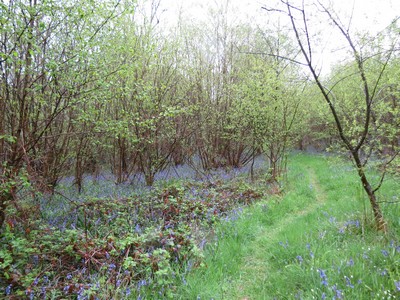
The morning’s walk took us through coppice wood with its charcoal burner’s hut, wonderful native deciduous woodland, much of it coppiced to retain open areas. Song thrush, willow warbler and the deeper notes of garden warbler accompanied us, and the sheets of bluebells everywhere more than compensated for the grey skies overhead. In fact wild flowers were in abundance, throughout the reserve, wild daffodil and primrose, anemones, stitchwort, ransoms, cuckoo flowers and various fungi to name a few.
Bluebell woodland


The trail took us out of the woods and lead us to open landscapes with great views of the Rusland valley and  it’s  river course. Further on we come to the white moss tarn; on the water we saw mute swans, tufted duck, mallard, little grebe and a greylag goose with her goslings.
Leaving the woods


Eventually the rain had the better of us and we returned to the visitor centre for some lunch. (Hot and cold drink facilities on site by the way)

The visitor centre /museum  has several  feeding stations, very busy stations with siskins, redpolls, goldfinch  and chaffinch vying for space  on a niger tube, whilst  various tits and a nuthatch shared a nut feeder. Further away a great spotted woodpecker was feasting on peanut feeder hanging on a tree, not much competition there!
A welcome tick of the day was an obliging spotted flycatcher seen in the trees behind the centre. Whilst an engaging pair of swallows were very busy flying in and out of the barn were they had nested.

The reserve is home to red and roe deer; here we were not disappointed a large herd of red deer, over 50 individuals wandered out of the undergrowth into open pasture.  Ears pricked, not doubt listening to every word we uttered (just as well as there were several signs of poacher alert warnings dotted around the reserve)
Red deer herd


Cheered by this company, and the eventual lifting of the weather, we headed off for a completely different habitat. The SSSI sites of Hay bridge Moss and Rusland Moss, a raised lowland bog, is edged by the intermediate Lagg Fen, a very wet area of willow and alder, thickly covered in mosses and a rich plant habitat in its own right.  
A wooden board walkway leads through the mosses, this in an area noted for other wildlife, sadly absent due to the inclement weather, dragon and damselflies, newts, common frogs and toads. Adders, slowworms and common lizards are also found on the reserve, alas no sunny spot for basking today.

A word of warning for visitors  to the reserve on wet days, please take care on the wooden bridges and boards,  these can be extremely slippy, sadly discovered by one of our party who ended up with a sore  purple rump and worse, a pair of broken binos

Nearing the wooden bridge on the trail our party had its first sighting of another good tick for the day, pied flycatcher, a fine female flitting about a nearby shrub. Further along the trail and out in the open mossland, where there was less cover for birds, a tree pipit was observed perched high in a solitary tree. This area showed obvious signs of conservation management, clearance of trees to preserve the mosslands.

The path we were on is a circular route however a little further on we had to turn back  as the ground was too sodden to continue, but not before a few of our party  had a brief view of a  red kite  swooping down from it’s lofty perch and down into the tree line. Mute swan and Shelduck grazed the fields beyond and a pheasant’s harsh call was a regular background cry.

We retraced our steps to the centre; again a pied flycatcher was espied, this time a splendid male.  Redstarts are regular breeders here on the mosses and were keenly sort after by the group , however only a couple managed the next sighting  of this elusive bird , sighted by Terry and Sean a little  further down the trial.

On our return to the visitor centre, we sat on the terrace, telescopes trained on the hillside and tops, hopeful of a sighting of Red kite, honey buzzard or osprey’s returning from fishing trips to the Duddon estuary ...  Not today... the mute swans and shelduck from earlier did a flypast and a single goosander was the unexpected bird.
In search of osprey, kite and buzzards 

All in all, despite very unfavourable conditions, we had an excellent day out, and were very grateful to Terry, who is a member of the reserve, for guiding us.

If you plan a visit don’t forget to have a look around the museum/workshop, some interesting bird’s nests, tactile mammal skins, deer antlers and exhibits on show.
Oh and if you find a sodden blue, silver flecked woollen scarf in the woodland. It’s mine!(Laura)

Bird List

Siskin, robin, crow, chaffinch, gt spotted woodpecker, blackbird, mute swan, greylag goose, tufted duck, tree pipit, lesser redpoll, gt tit, coal tit, spotted flycatcher, swallow, pheasant, swifts, reed bunting, rook, lesser bb gull, shelduck, mallard, red kite, pied flycatcher, willow warbler, wren, nuthatch, goldfinch, buzzard and little grebe


Report compiled by Anne and Laura